
Case Study: Wales, United Kingdom
Introducing default 20mph speed limit
Location: Wales, United Kingdom
Scale: National policy
Policy Type: Default 20mph (30km/h) on restricted roads [1]
Year Initiated: The Wales 20mph Task Force Group formed May 2019
Effective Date: September 17, 2023
Geographic Scope: The policy applies to all restricted roads nationally, on implementation it applied to 37% of the Welsh road network, by length. Exceptions allowing 30mph limits are based on the Safe System foundations. On implementation the policy applied to 37% of roads in Wales by length.
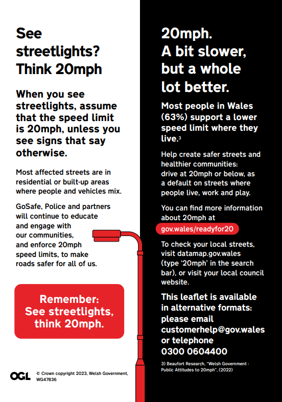
[1] Restricted roads have streetlights on them placed no more than 200 yards (184m) apart. They are usually in residential and built-up areas.
“The rationale for reducing speed limits on restricted roads to 20mph is much wider than simply reducing traffic speeds. It is intended to be a major behaviour change programme which benefits communities and the well-being of people in Wales.
Introducing a lower speed limit for traffic is expected to reduce the likelihood and severity of collisions on our roads. This will lead to fewer pedestrians and cyclists being seriously or fatally injured. The lower speed limit is designed to support the Welsh Government’s vision for walking, wheeling and cycling to be the natural mode of choice for short everyday journeys.”
Area Profile
Population density across Wales varies significantly from Cardiff at 2,572 residents/km2 to Powys at 26 residents/km2.
Car accessibility (car dependency): 88% of population has a car available for use.
Public transport usage: Public transport is dominated by buses. 12% of population uses a bus at least once a week, 4% use a train once a week.
Usual mode of commuting: 75% used a private vehicle, 14% walked, 4% cycled. 51% of people travelled between 3-15 miles to work, 26% travelled more than 15 miles.
Travel to school: 34% of secondary school and 44% of primary school children walk or cycle to school at least some of the time8.
2. Policy Overview
What changed?
The default speed limit on restricted roads was lowered from 30mph to 20mph.
National implementation was simultaneous (post trial in 8 regions)
Political Pathway
Who initiated the proposal?
Proposal was initiated by the First Minister (Welsh Labour) in a statement to the Welsh Parliament on 7 May 2019 that 20mph should be the default speed and a Task Force Group should be established to identify the actions required for implementation.
Governance level
National – Welsh Government
Task Force Group report was published July 2020. The Senedd voted to accept report’s recommendations and Welsh Government started work to implement.
Was legislation required?
Section 81(1) of the Road Traffic Regulation Act was amended to reduce default speed limit on restricted roads from 30mph to 20mph.
The Traffic Signs Regulations and General Directions 2016 (TSRGD) was amended to create a Wales-only TSRGD 2023.
Time from proposal to implementation
4+ years: first raised in parliament on May 7, 2019 – implemented September 17, 2023
3. Stakeholders
& Roles
|
Stakeholder |
Role in Process |
|
Councils: All 22 Welsh Local Authorities |
Councils (highway authorities) were responsible for implementing the
policy in their regions, including: ●
Identifying
exception roads (remain at 30mph) ●
Submitting
TROs for exceptions3 ●
Changing
signs and road markings. |
|
State transport agency: Transport for Wales |
TfW created the tools to help determine exception roads. Manage the ongoing monitoring of the policy and offer guidance on
amendments5,14. |
|
Emergency Services: 4 Police forces and 3 Fire and Rescue Services15 |
Emergency services publicly backed the 20mph policy. Police were involved in enforcement and raising awareness of the new
limits. Fire and rescue offered roadside engagement sessions for low level
speeding drivers as an alternative to prosecution. |
|
Coalition Groups |
Public Health Wales: published peer reviewed research in 2017 on
casualty and cost savings from 20mph. Support from Institute of Welsh Affairs, Royal College of
Paediatrics, BRAKE Road Safety Charity, RAC Foundation. Plaid Cymru and Wales Greens |
|
Advocacy groups: 20 s Plenty, GoSafe,
Sustrans (now Walk Wheel Cycle Trust), Living Streets |
Grassroots advocacy helped to normalise the idea of 20mph as a public
health and active transport policy. Living Streets launched the #GetWalesWalking campaign at the
Parliament in 2016, supported by other advocacy groups. |
|
Community groups |
Community groups were supported by advocacy groups, 20 s Plenty and
Sustrans. Some regions with active community groups became 20mph trial areas. |
|
Opposition actors |
Motoring groups: e.g., Alliance of British Drivers Reform UK and Welsh Conservatives |
|
Other engaged groups: Logistics and haulage companies, bus companies,
delivery companies, Disability and Guide Dogs.11 |
Represented on the Task Force. |
|
Steering Group: Government Representatives, Welsh Local Government
Association (WLGA), Transport for Wales (TfW), local authorities, Police,
Public Health Wales, 3rd sector organisations, academics, experts.11 |
Responsible for how the 20mph policy was planned, coordinated,
enforced and monitored across agencies and local authorities. |
4. Catalysts & Triggers
Factors that lead up to the First Minister, Mark Drakeford, stating that 20mph should be the default speed limit in residential areas on May 7, 2019 included:
Reduction in casualty numbers and savings to the health service – potentially influenced by the Public Health Wales 2017 research paper
Convergence of a number of Welsh Government policies:
2013 Road Safety Policy targeting reductions in fatalities and serious injuries
Alignment to the 2020 Stockholm Declaration to implement 20mph where vulnerable road users and vehicles frequently mix
Well-being of Future Generations (Wales) Act and Active Travel (Wales) Act
Visible grassroots and NGO support:
20’s Plenty was supporting 400 community groups around the country who wanted 20mph in residential streets
50 councils in England had already reduced residential street limits to 20mph.
In 2021, the 20mph default speed limit was included in both Welsh Labour and Plaid Cymru’s election manifestos.
5. Communications & Community Engagement
Communications Strategy
Core messaging frames used were:
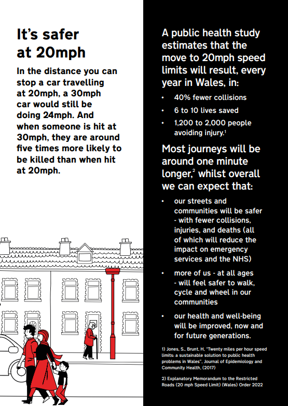
Safety – 6-10 lives saved and 1,200 to 2,000 casualties avoided each year
Public Health Savings – £92 million each year
Liveable communities – lower speeds will create ‘safer, better communities to live, work and lead our lives”, the policy provides a safer environment for active transport, and it reduces air pollution and noise.
Narratives used:
The policy is evidence based and supported by people living in 20mph area
It is not a blanket approach, there are exceptions where appropriate – “Getting the right speed on the right road”
Outcome: Early data shows that it is working
Community Engagement Methods
Public consultation period: 12-week consultation period from July 2021-August 2021, managed via an online/downloadable form which was open to individuals and organisations. Consultation Received 6,018 responses (47% in favour). 25 organisations made submissions (22 in favour)[12].
Community survey: Public opinion survey was carried out in Nov 2020 as part of omnibus survey of 1,000 adults19.
Pilot program: The 20mph default was trialled in eight areas across Wales in 2021-2022, which were used to, as well as implementation issues. Pilot settlement project in 8 areas which implemented area-wide 20mph limits between 2021-2022. These were used to test community engagement messaging, refine the implementation process and test helped to refine the process, including use of the GIS tool for identifying exception roads[11].
Level of Community Support
Prior to implementation there was a high level of community support. In November 2020, 81% of adults supported the policy and 18% opposed. At implementation in September 2023 opposition had increased to 61% and 3-months post-implementation opposition was 70%20.
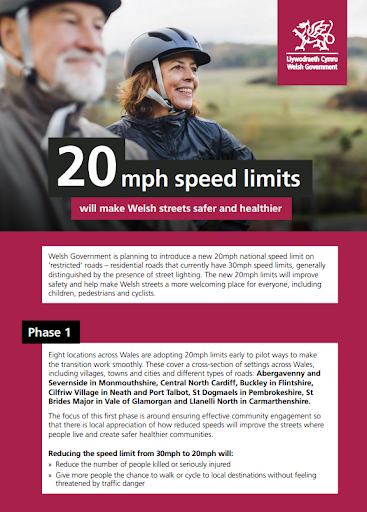
In June 2024 a petition to reverse the 20mph limit received nearly 500,000 signatures – the largest petition ever brought against the Welsh Parliament21.
A 2026 survey showed that 54% of people oppose the limit and 30% support it, while in the 16–34-year-old age group, opposition is 49%.21
6. Implementation Approach
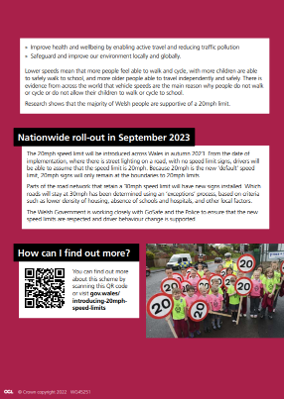
The long period between the Order and its implementation, (from July 13, 2022 to Sept 17, 2023) was to allow for amendments to traffic signs, as well as review, submission and implementation of exception roads.
Sign and Road Marking Changes22
This was implemented through amendments to the Traffic Signs Regulations and General Directions 2016 (TSRGD) to create a Wales-only TSRGD 2023.
The TSRGD 2016 amendments reflected the default nature of 20mph; removal of repeater signs in 20mph areas and their introduction in 30mph areas, 20mph zones (and their signage) were abolished, traffic-calmed-area entry and exit signs to replace 20mph zone signed at school zones, traffic calmed areas and road humps nested in default 20mph area (to replace 20mph repeater signs). These changes were phased:
Changes required by Implementation:
● All terminal 30mph signs to be changed to 20mph signs
● Removal or change of any conflicting signs e.g., 30mph Speed Camera Ahead signs
● All 30mph road markings
12-month grace period:
● Removal of repeater signs in 20mph areas
● Removal of 20mph zones and their signs
● Installation of traffic calmed area signs for 20mph nested school zones/road humps/traffic calmed areas.
● Temporary ‘New 20mph Limit’ were installed at selected locations for 12 months post implementation.
5-year grace period:
● 20mph speed limit road marking roundels
Note - Vehicle Activated Signage (VAS) for 20mph are allowed to be used at local authority discretion despite being repeater signs13.
Enforcement
● There was a two-month grace period in enforcement before fines were issued from November 2023.
20mph exceptions review
● Local authorities already had the power to set different speed limits on their road, via the Traffic Regulation Order (TRO). This power remains in place.
● In Nov 2022 government issued a GIS mapping tool and guidance document for traffic authorities to assess which restricted roads could be increased to 30mph. Local authorities required to review their entire road network against the framework to assess for exceptions. A TRO was submitted for any roads assessed to remain as 30mph.
Cost of Implementation
Total cost of implementation has been around £32 million. The funds came from the Welsh Government’s budget allocations for transport and policy implementation.
|
2019 |
|
|
2021 |
|
|
2023 |
|
|
|
|||
|
May |
Statement in parliament by First Minister for 20mph default on
restricted roads. Task Force established. |
|
June |
Trial of 20mph in eight pilot areas for approx. 12 to 18 months. |
|
July |
Traffic Sign Regulations and General Directions amended following 3-month consultation
period. |
|
|
|||
|
|
|
|
|
|
|
|
||||||
|
|
|
|
|
|
|
|
|
|
|
|
|
|
|
|
|
|
|
|
|
|
|
|
|
|
|
|
|
|
|
|
Welsh 20mph Task Force Group issues their final report |
|
|
Road Traffic Regulation Act amended to 20mph default speed on
restricted roads. |
|
|
National rollout of 20mph default speed on restricted roads. |
|||
|
|
|
July |
|
July |
|
Sept |
||||||
|
|
|
2020 |
|
|
2022 |
|
|
2023 |
|
|||
7. Outcomes & Evidence
Safety Outcomes from 12 months of implementation
● 11.8% decrease in total road casualties in first 12 months. 26.2% decrease on 20 and 30mph roads and 4.2% increase on >40mph roads. Not enough data to assess pedestrian and cyclist casualty trends (requires 3 years data).23
● Casualty data shows 100 fewer people killed or seriously injured in July to Sept 2024, 35% lower than the same period in 2023 (prior to implementation), and lowest 3-month period since 1979 when records began. However, government officials urge caution in attributing the fall to 20mph.24
Compliance Outcomes from 18 months of implementation23
● 54% of vehicles driven at or below 24mph (vs 20.8% before implementation).
● Average speed reduction of 3.8mph on 20mph main through roads.
● 85th percentile[1] speed reduction of 3.4mph on 20mph.
Other Impacts23
● No data on active travel levels post-implementation. Phase 1 research showed 25% increase in active travel journeys to school in phase 1 20mph areas versus an 18% increase in control areas.
● No material difference in air quality (NO2, PM10 and PM2.5 results, available for pilot settlements only, CO2 emissions data not yet available).
● Average journey time increased in 57/60 cases: 44 cases ≤ 2min, 13 cases > 2min. Journey time variability reduced in 45/60, providing greater certainty.
● Government evaluation into changes in public attitudes to 20mph speed limits has not yet been published. Publication date has not been given.
The Welsh Government will commission a full, independent evaluation of the policy within 5 years of implementation, this is expected in 2029.25
[1] Speed at which 85% of drivers drive at or below in free-flowing conditions.
8. Lessons Learned & Key Takeaways
Key Lessons
● Political enablers26
○ Momentum towards 20mph internationally and other parts of the UK
○ Early survey (Nov 2020) showing 81% support for 20mph gave the government a mandate
○ Cross-party support in parliament to commence the reform and for the recommendations in the Task Force Group’s final report
○ Strong coalition support from other Welsh organisations and NGOs
○ Policy alignment with Well-being and Active transport Acts, and 2020 Stockholm Declaration10
● Common objections and how addressed
○ 20mph is not appropriate for all restricted roads – addressed by developing an ‘exceptions process’26
○ Increase to emergency service response times – acknowledged that while emergency vehicle speeds wouldn’t be restricted, private travel of first responders to the depot would be, potentially increasing response times. Emergency services addressed this by reaffirming their support for the policy and highlighting the reduction in deaths, serious injuries and mental health impacts on first responders arising from the policy27
● Coalition-building insights
○ Welsh Labour formed a co-operation agreement with Plaid Cymru to both support flagship policies, including 20mph. Both parties included it in their 2021 election manifestos, allowing them to claim an electoral mandate.
○ The Task Force Group included representatives from a wide range of organisations, providing input and support10
● Communications insights
○ Have a simple, clear, consistent story (safer communities, reduced injuries and deaths) but include clear explanations of the exceptions process from the outset ⮚ addresses concerns of ‘blanket’ implementation.
○ Ensure communications campaign is strong and delivered early in the process ⮚ prevents misinformation and opponents from dominating the media landscape
○ Implement a two-way consultation from the outset ⮚ genuine listening program could have acknowledged and addressed concerns early, preventing later revisions
○ Prominent use of real-life data from pilot studies and early monitoring, rather than modelled data ⮚ makes the benefits relatable and human
○ Match the intensity of the campaign to the scale and political impact of the campaign ⮚ don’t underestimate the negative sentiment impact and use all the tools you can to bring the community with you.
What Would They Do Differently?
● Apply more nuance and common sense to which roads should be 20mph. A blanket approach meant that some roads were dropped to 20mph even when there was no safety benefit, which became the focus for a lot of the negative sentiment. Adopting a sensible exceptions approach, with all roads reviewed at the council level, would have avoided this issue. An exceptions review is now being conducted and, as a result, some roads will revert back to 30mph.28
● Government should have done more to prepare communities for the change. Communication was too limited, there wasn’t enough advertising and engagement wasn’t consultative enough. The government underestimated the magnitude of the change for communities and opposition to the policy was greater and more long lasting than anticipated. It needed a whole of government response, across multiple departments and portfolios, but that didn’t happen.8 Because the government didn’t control early messaging with a strong, simple campaign, misinformation and opposition messaging was allowed to dominate.
● Government should have been more consultative from the outset. The campaign focused on the benefits but didn’t really engage in a 2-way dialogue. They only implemented their listening campaign once opposition had grown.
Transferable Insights for Australian Context:
Implementation lesson: Addressing 40km/h school zones ‘nested’ in a 30km/h default road network – following Welsh strategy on 20mph zones.
Conduct a road-by-road assessment at a council level to identify roads suitable for 30km/h or 40km/h. School zones and HPAA would be assessed for reduction to 30km/h
Abolish 30km/h repeater signs, as per rules of default speed limit. School and HPAA zones ‘nested’ in 30km/h area will not need (repeater) speed limits signs, just ‘school’ and ‘HPAA’ signs to warn drivers.
Communication and scope lesson: Avoiding accusations of a ‘blanket rollout’ approach. Have a clear and fact-based exceptions process, and communicate it widely. Have a simple, repeated core story (e.g., safety) but pair it with information on the scope of the change. Wales has pivoted their campaign to ‘getting the right speeds on the right roads’.
Communication lesson: Match the information campaign to the magnitude of the campaign, and be prepared for intense opposition. A national change takes a whole of government response.
Consultation lesson: Consult widely and consistently from the outset. Make sure all communication is two-way, take the time to bring the community with you and genuinely consider and address their concerns.
References
https://www.gov.wales/setting-30mph-speed-limits-restricted-roads-guidance-highway-authorities
https://www.walesonline.co.uk/news/wales-news/full-list-20mph-roads-wales-33297860
https://www.gov.wales/setting-30mph-speed-limits-restricted-roads-guidance-highway-authorities-html
https://tfw.wales/default-20mph-speed-limit-on-restricted-roads
https://www.gov.wales/statistics-wales-demography-newsletter-august-2022-html
https://www.gov.wales/transport-national-survey-wales-april-2022-march-2023-html
https://www.gov.wales/introducing-default-20mph-speed-limits
https://www.gov.wales/sites/default/files/publications/2020-07/20mph-task-force-group-report.pdf
https://www.gov.wales/traffic-signs-regulations-and-general-directions-wales-summary-report-html
https://tfw.wales/vehicle-speed-monitoring-data-july-2023-to-september-2025
https://www.gov.wales/written-statement-enforcement-new-20mph-default-speed-limit
https://www.gov.wales/sites/default/files/publications/2023-08/20-mph-campaign-english-leaflet.pdf
https://www.gov.wales/lets-work-together-get-right-speeds-right-roads
https://www.gov.wales/written-statement-20mph-early-speed-data
https://www.walesonline.co.uk/news/politics/yougov-poll-shows-falling-support-28275981
https://tfw.wales/sites/default/files/2025-07/20mph-National-Monitoring-Report_July-2025_ENG.pdf
https://www.gov.wales/proposal-reduce-speed-limit-20mph-residential-streets-summary-responses-html
https://www.walesonline.co.uk/news/wales-news/leaked-police-email-suggests-20mph-27522424