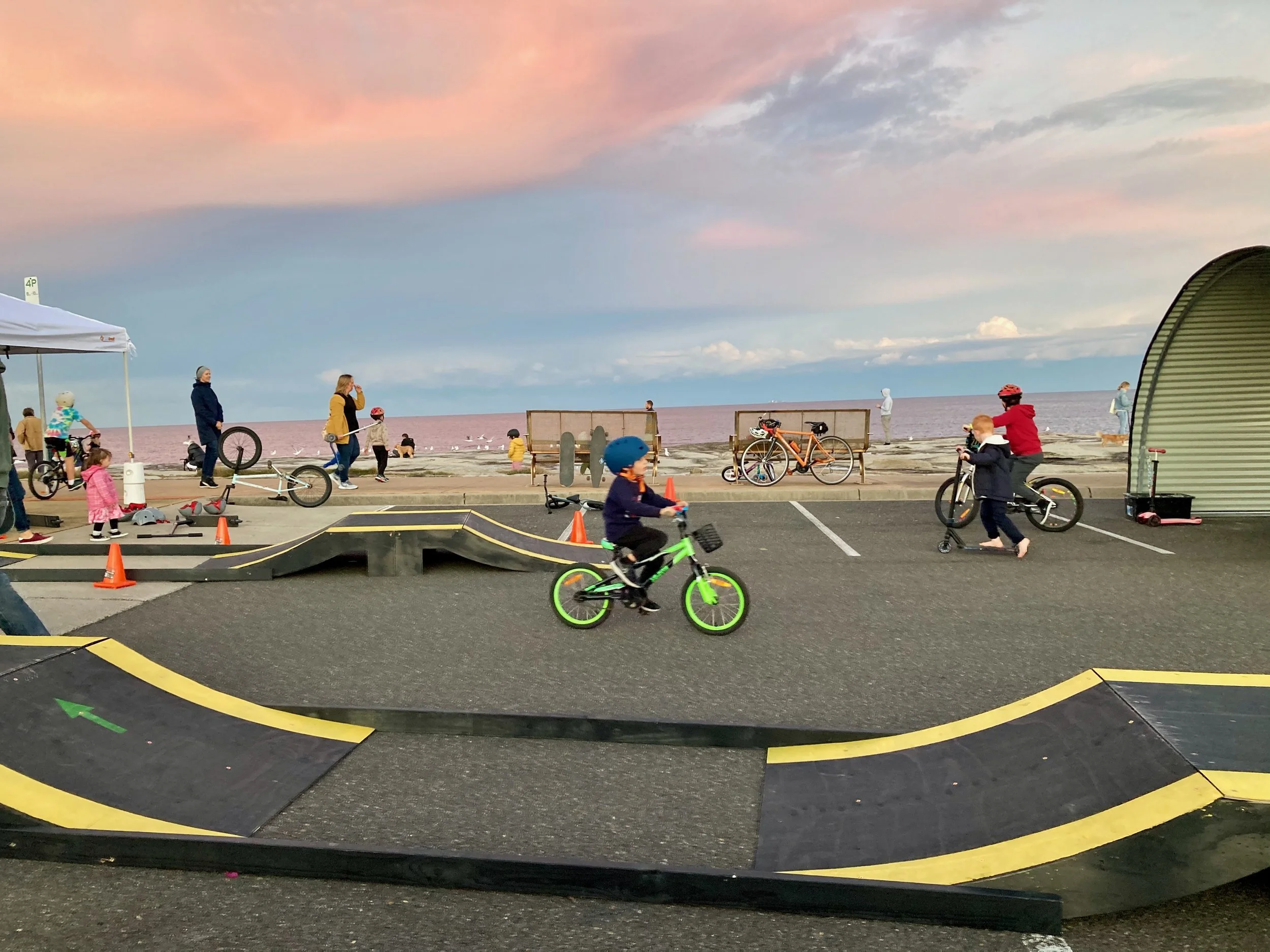
Randwick bicycle network
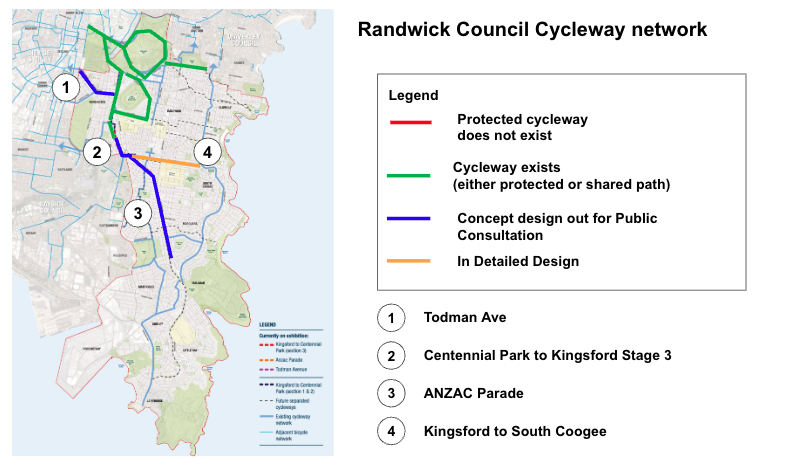
Randwick Council Cycleway network (built, in design and out for consultation)
For decades, people have been asking for safer ways to walk and ride around Randwick (NSW). Randwick council currently has the concept designs for 3 sections of the cycleway network out for public consultations. Please take 5 minutes to support the following projects:
Todman Avenue (1.3 kms between South Dowling Street to Doncaster Avenue)
Anzac Parade (2.5 kms between Kingsford to Maroubra Junction)
Together, that’s 4.5 kilometres of cycling infrastructure that will help people of all ages and abilities travel safely to school, university, shops, parks, public transport and local destinations.
For too long, many people have been locked out of riding a bike because the existing network is fragmented or requires sharing busy roads with fast-moving traffic. These projects help close critical gaps and move Randwick closer to a connected network that works for everyone, not just confident riders.
Predictably, the proposals have attracted some opposition. So let's take a look at some of the most common claims and compare them with the facts.
Myth Busters / FAQ
Myth 1 - Building a cycleway down the middle of Anzac parade is a waste of money as the Light Rail extension from Kingsford to Maroubra will rip up the cycleway.
Fact - There are no plans for Light Rail extension. Plans from TfNSW did not identify a light rail extension. There is a 2020 TfNSW Strategy for a Metro …
Transport for NSW’s Future Transport 2056 - South East Sydney Transport Strategy - designates South East Sydney (CBD to Zetland, Maroubra, and La Perouse) as a key Visionary / Long-Term Rapid Transit Corridor for high-capacity mass transit investigation.
“Prioritising the delivery of Metro to the South East instead of light rail to Maroubra Junction, with Metro to provide the higher capacity to meet the higher demand now expected in the medium and longer term, and provide the catalytic opportunity for place development in station locations” (pg 34). Light rail was considered as a scenario, however, Metro extension was determined to be the preferred scenario.
Myth 2 - No one will use it.
Fact - Experience from similar separated cycleways in Sydney shows cycling numbers typically increase after safe infrastructure is installed because many people are willing to ride only when they feel protected from traffic. The Randwick Integrated Transport Strategy aims to increase active transport mode share from 26% to 35% by 2031and reduce private vehicle trips. The project is intended to help achieve these targets by providing safer infrastructure that encourages more people to walk and ride. The Anzac Parade Paths project is not an isolated proposal but one that directly implements Council's adopted transport policies and strategic objectives.Only lycra cyclists will use it - Separated cycleways are intended for everyday users—children, families, commuters, older adults and people using e-bikes—not just experienced cyclists. Recent NSW Government data highlights strong and growing demand for safe cycling infrastructure. Bike riding increased by 45% in Randwick, 170% in Waverley and 403% in the City of Sydney. The City of Sydney’s extensive, connected cycleway network clearly shows that when safe, continuous infrastructure is delivered, people use it—proving that if you build it, they will come. Randwick’s growth, despite a lack of connected routes, points to even greater potential.
Randwick alone has experienced up to 190% increase in people riding on the cycleway usage along Doncaster Avenue and Houston Road after a year of opening of Stage 1 and 2 of the Kingsford to Centennial Park project. (RCC March 2026 Council Report)
Also, Share e-bike usage in Randwick has increased at an exceptionally rapid rate, growing almost fivefold in two years. Trips rose from approximately 128,000 in 2023 to more than 628,000 in 2025, representing an average growth rate of over 120% per year, alongside a doubling of fleet size and increased daily use per bike—making share e-bikes one of the fastest-growing transport modes in the LGA. (RCC February 2026 Council Report)
These number alone show the number of people riding their bikes around Randwick and the need for safe riding infrastructure to protect the vulnerable transport users of our community.
Myth 3: Parking - Removing parking will destroy local businesses -
Fact: Research from Australia and overseas often finds little long-term negative impact on businesses, and in some cases increased foot traffic and local spending from people walking and cycling. Every major cycleway proposal in Sydney has attracted predictions that local businesses would suffer. Those concerns are understandable, but they should be considered alongside the growing body of evidence showing that well-designed active transport projects can help create more vibrant, accessible shopping streets https://sydney.org.au/wp-content/uploads/2024/11/The-business-case-for-walking-and-cycling.pdf .
Myth 4: Traffic congestion will become much worse.
Fact: Some delays can occur initially, but transport planning assumes that when attractive alternatives are provided, some trips shift to walking, cycling or public transport.
With various high density developments planned in Randwick centres, traffic congestion is inevitable when road space is limited and the option of road expansion is minimal. These projects will provide the safe infrastructure that will give residents and visitors the choices rather than driving to alleviate the traffic congestion.
Myth 5: The project is anti-car.
Fact: The stated aim is not to eliminate car access but to provide safer travel options and rebalance road space in line with Council's transport hierarchy and state active transport policies. The Randwick Transport Mode Hierarchy explicitly prioritises walking, public transport and cycling ahead of private vehicles. The project reflects this adopted policy by reallocating road space to higher-priority transport modes, while still maintaining vehicle access.
Myth 6: There is no need for a separated cycleway.
Fact: While many local streets are suitable for cycling, busy arterial roads such as Anzac Parade can be intimidating for less experienced riders due to higher traffic volumes and speeds. The Randwick Active Transport Plan recognises that safe, connected infrastructure is needed for people of all ages and abilities to ride confidently. The Randwick Integrated Transport Strategy therefore prioritises delivering fully separated cycleways where possible, while the Randwick Transport Mode Hierarchy places walking and cycling at the top of Council's transport priorities. The Anzac Parade Paths project fills a key gap in the active transport network by providing a safer route along one of Randwick's busiest transport corridors.
The Randwick Integrated Transport Strategy commits to delivering an additional 30 km of safe cycling routes by 2031, prioritising fully separated bicycle lanes where possible. The Anzac Parade Paths project is a direct implementation of this strategy. In fact it is a State Priority Cycleway Route.
Between 2017 and 2021, 235 crashes involving a bike rider occurred within Randwick LGA. Randwick City Council’s Active Transport Plan also identified safety as the primary barrier: The plan identifies perceived and actual traffic danger as the number one barrier preventing community participation in cycling (especially for children, older adults, and women).
The increase in the number of bicycle ridership within Randwick LGA also shows the community needs.
Myth 7: The project only benefits experienced cyclists.
Fact: The Randwick Active Transport Plan is designed to deliver infrastructure that enables people of all ages and abilities to walk and ride safely and comfortably. The project is intended for families, children, older adults and everyday riders, not just confident cyclists.
Myth 8: Walking and cycling improvements aren't a Council priority
Fact: All three adopted strategies - the Transport Mode Hierarchy, Integrated Transport Strategy, and Active Transport Plan - identify walking and cycling as key priorities for improving transport, health, safety and sustainability across Randwick.
Myth 9: The project is just a local footpath upgrade.
Fact: The project delivers multiple objectives across all three strategies by improving active transport connections, supporting public transport access, creating safer infrastructure, and contributing to Council's long-term vision for a more sustainable and connected transport network.
Myth 10: It's a waste of money to build the cycleway now if it will just be ripped up for future transport projects in 20 years.
Fact: The Randwick Transport Mode Hierarchy, Randwick Integrated Transport Strategy and Randwick Active Transport Plan all identify safe walking and cycling infrastructure as a current priority, not one to be deferred for decades. The project delivers immediate safety, accessibility and active transport benefits while supporting Council's targets to increase walking and cycling by 2031. Any future major transport project would be subject to its own planning and funding processes, and there is no certainty that the cycleway would need to be removed. Investing in active transport now ensures the community benefits over the coming decades rather than waiting for a future project that may not occur for many years.
Myth 11: Just wait for the metro or light rail project to be delivered, cycleway can wait.
Fact: While a cycleway along Anzac Parade has been identified in planning documents since 1998, the Randwick Transport Mode Hierarchy, Randwick Integrated Transport Strategy, and Randwick Active Transport Plan all identify safe walking and cycling infrastructure as a current priority. The project delivers immediate safety, accessibility and connectivity benefits and contributes to Council's target of increasing active transport by 2031. Future major transport projects remain subject to separate planning, funding and government decisions, making their timing and design uncertain. Delaying the cycleway would postpone the benefits to the community for many years.
Anzac Parade has had a notably high number of crash locations especially at the intersections with Fitzgerald Avenue, Maroubra Road, Forrest Street and Bilga Crescent (Active Transport Plan). Anzac Parade paths will provide separate infrastructure that will protect the community members.
Myth 12: This project will only benefit a small section of the community.
Fact: The Anzac Parade Paths project is designed to benefit a broad cross-section of the community, not just people who cycle. In line with the Randwick Active Transport Plan, it provides safer, more accessible infrastructure for people of all ages and abilities to walk, ride, use mobility devices and connect to public transport. The project also supports the Randwick Transport Mode Hierarchy by improving the highest-priority transport modes, and helps deliver the Randwick Integrated Transport Strategy by encouraging more walking and cycling, reducing reliance on private vehicles and improving access to schools, parks, businesses and the light rail. Even people who continue to drive can benefit if more trips shift to walking and cycling, reducing pressure on the road network and parking over time.
These projects are the top 3 priority routes in Randwick, identified by the community. These spine routes will be the artery that connects to city centres and communities in Randwick.
Myth 13: The Anzac Parade Paths project is just a Randwick Council initiative and isn't supported by the NSW Government.
Fact: The project aligns with the NSW Active Transport Strategy, which supports investment in connected, separated walking and cycling infrastructure and encourages partnerships with councils to deliver strategic active transport corridors. This strategy recognises walking and cycling as essential transport modes for everyday trips to work, school, shops and public transport, helping reduce congestion, improve health and create more sustainable communities.
Myth 14: Cycleways are really expensive.
Fact: While separated cycleways require an upfront investment, they are generally much less expensive than major road or motorway projects and provide long-term benefits beyond cycling. The NSW Active Transport Strategy recognises that investment in walking and cycling infrastructure improves safety, supports healthier communities, reduces congestion, enhances access to public transport and creates more sustainable neighbourhoods. The Anzac Parade Paths project also includes upgraded footpaths, crossings, landscaping and safety improvements, delivering benefits for a wide range of road users.
Myth 15: Building better walking and cycling paths won't change how people travel.
Fact: Safe, connected infrastructure is one of the biggest factors influencing whether people choose to walk or ride. The Anzac Parade Paths Project will make active travel a realistic option for short trips and school journeys, helping more children walk, ride and scoot safely. This is important at a time when only around 30% of children meet recommended physical activity levels, and the proportion of children actively travelling to school has fallen from 75% to 25% over the past 40 years.https://www.vu.edu.au/sites/default/files/getting-australias-health-on-track-mitchell-institute.pdfhttps://pubmed.ncbi.nlm.nih.gov/17628653/
Randwick alone has experienced up to 190% increase in people riding on the cycleway usage along Doncaster Avenue and Houston Road after a year of opening of Stage 1 and 2 of the Kingsford to Centennial Park project (RCC March 2026 Council Report)
Share e-bike usage in Randwick has increased at an exceptionally rapid rate, growing almost fivefold in two years. Trips rose from approximately 128,000 in 2023 to more than 628,000 in 2025, representing an average growth rate of over 120% per year, alongside a doubling of fleet size and increased daily use per bike—making share e-bikes one of the fastest-growing transport modes in the LGA (RCC February 2026 Council Report).
Myth 16: There isn't enough demand for a separated cycleway on Anzac Parade.
Fact: NSW Government data shows cycling is already growing rapidly across Sydney, with bike riding increasing by 45% in Randwick, 170% in Waverley and 403% in the City of Sydney. The City of Sydney demonstrates that when safe, connected cycleways are built, people use them. Randwick's growth despite having a fragmented network suggests demand could be even greater with safe, continuous infrastructure.
Myth 17: We can't build a metro through Randwick because it sits above the Botany Sands Aquifer.
Fact: The presence of the Botany Sands Aquifer does not prevent an underground metro from being built. Around the world, and in Sydney itself, major tunnels have been successfully constructed beneath rivers, harbours and groundwater-bearing soils using modern tunnelling techniques. For example, Sydney Metro tunnels pass beneath Sydney Harbour, one of the city's most challenging geological environments, while protecting surrounding groundwater and infrastructure. Building beneath the Botany Sands Aquifer would require careful engineering, environmental assessment and groundwater management, but it is an engineering challenge—not a barrier. Whether a metro is built through Randwick will ultimately depend on government planning, funding and transport priorities, not the existence of the aquifer alone.
Tree facts
The arborist identified 585 trees, only on the side of the median where the cycleway was proposed, and did not count trees on the other side, so the number of trees in the project area could be about 700. Of these 54 have been identified for removal and replacement. No significant trees are proposed for removal.
It will require removing all the trees - The current concept has been designed to minimise tree loss, including routing much of the path through the median while retaining as much mature canopy as possible. The detailed design phase may identify further opportunities to reduce impacts.
Why These Projects Matter
The real question isn't whether every single person will use these routes.
The question is whether Randwick should provide safe transport options for people who want to travel without a car.
These projects connect schools, UNSW, Centennial Park, shopping areas, public transport and local neighbourhoods. They make cycling safer, walking easier and transport choices broader.
Most importantly, they help build a city where an eight-year-old child, an eighty-year-old resident, or anyone in between can move around safely without needing to drive everywhere.
That's a future worth supporting.
If you'd like to see a safer, healthier and more connected Randwick, make sure you have your say before the consultation closes.