
Shared E-Bikes Are Transforming NSW Streets -The Legislation Needs to Catch Up
Shared e-bikes are already changing how people move around New South Wales. Ridership is growing fast. The journeys people are making — to train stations, to work, across Local Government boundaries — show that this is transport, not recreation.
But the regulatory framework being proposed to govern it doesn't yet quite match that reality.
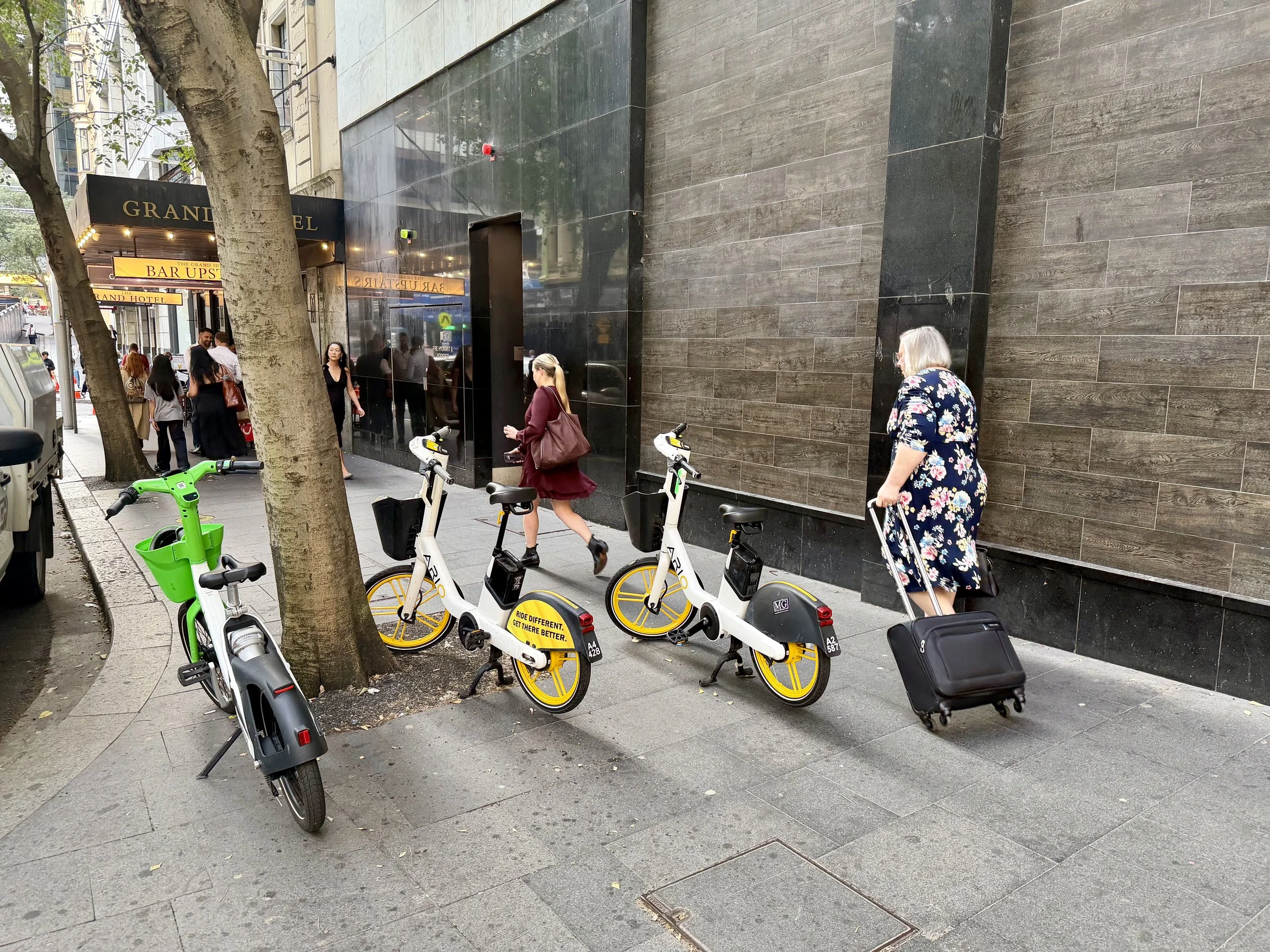
Shared e-micromobility bicycles parked across inner city footpath (Hunter Street), obstructing pedestrian accessibility (source: L Popowitz)
This week Better Streets made a submission to Transport for NSW's e-micromobility sharing schemes reform consultation, and our message is straight forward:
Treat shared e-micromobility as part of the transport network, and build the rules accordingly.
Right now, the proposed framework leaves too much to local councils — approvals, fleet management, parking standards — creating a patchwork of rules that will make the network harder to use, harder to scale, and harder to trust. Shared bikes don't stop at council boundaries. Nor should the governance.
Our submission calls on the NSW Government to:
State-level leadership = consistency
Regulation and approval of shared e-micromobility should sit with one authority — Transport for NSW — just as it does for buses and point-to-point transport. Councils can continue to manage local infrastructure, but consistency across the network requires state-level leadership.
Build a state-wide strategy
The reform package doesn't include a plan for coordinated rollout. Without one, services will cluster in inner suburbs and leave everyone else behind. A state-wide strategy should identify priority areas, set service expectations, and ensure the scheme works as a connected network.
Mandate on-street parking — not footpath parking
Shared bikes dumped on footpaths are a safety and accessibility problem. The fix isn't better signage — it's proper on-street parking bays, provisioned by reallocating car parking spaces, at transport hubs and at 300-metre intervals as a minimum. Footpath parking should be the last resort, not the default.
Make data a public asset
The data generated by a shared transport service operating on public streets belongs to the public. Requiring operators to supply data is not enough. The government should aggregate, standardise, and publish it so researchers, planners, and communities can use it.
Extend services to where people need them most
Without minimum service requirements, schemes will concentrate where demand is already high. Equitable access — in outer suburbs, around train stations, with fair pricing — needs to be built into the framework from the start.
Shared e-micromobility done well is a real mode shift opportunity. But good outcomes won't happen by accident. NSW has a chance to get this right — with coordinated leadership, clear rules, and streets designed for the people using them.
Read our full submission here.
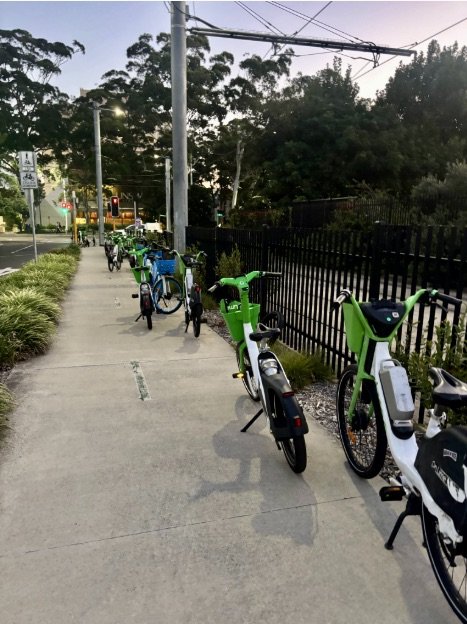
Wansey Road, Randwick. Shared e-micromobility bicyles parked on shared path next to the High Street light rail stop, next to the University of NSW (source: J Jung)
You can find more information on the E-micromobility sharing schemes reform here.
The deadline for submissions are Monday 4 May 2026.
