
When petrol hits $2.50 a litre, it's time to rethink how we move and how governments act.
“It’s created the perfect conditions for mode shift - economic motivation, public attention, and political permission to act”
The fuel crisis triggered by the Middle East conflict is painful — but it opens a rare window for lasting change to accelerate our transition to more sustainable modes of travel.
Australians filling up their cars are feeling a sharp sting at the bowser. National average unleaded petrol reached 219.5 cents per litre (week ending March 15), up from around 169 cents before the Middle East conflict intensified (Lee, 2026). Diesel prices are worse (NRMA, 2026).
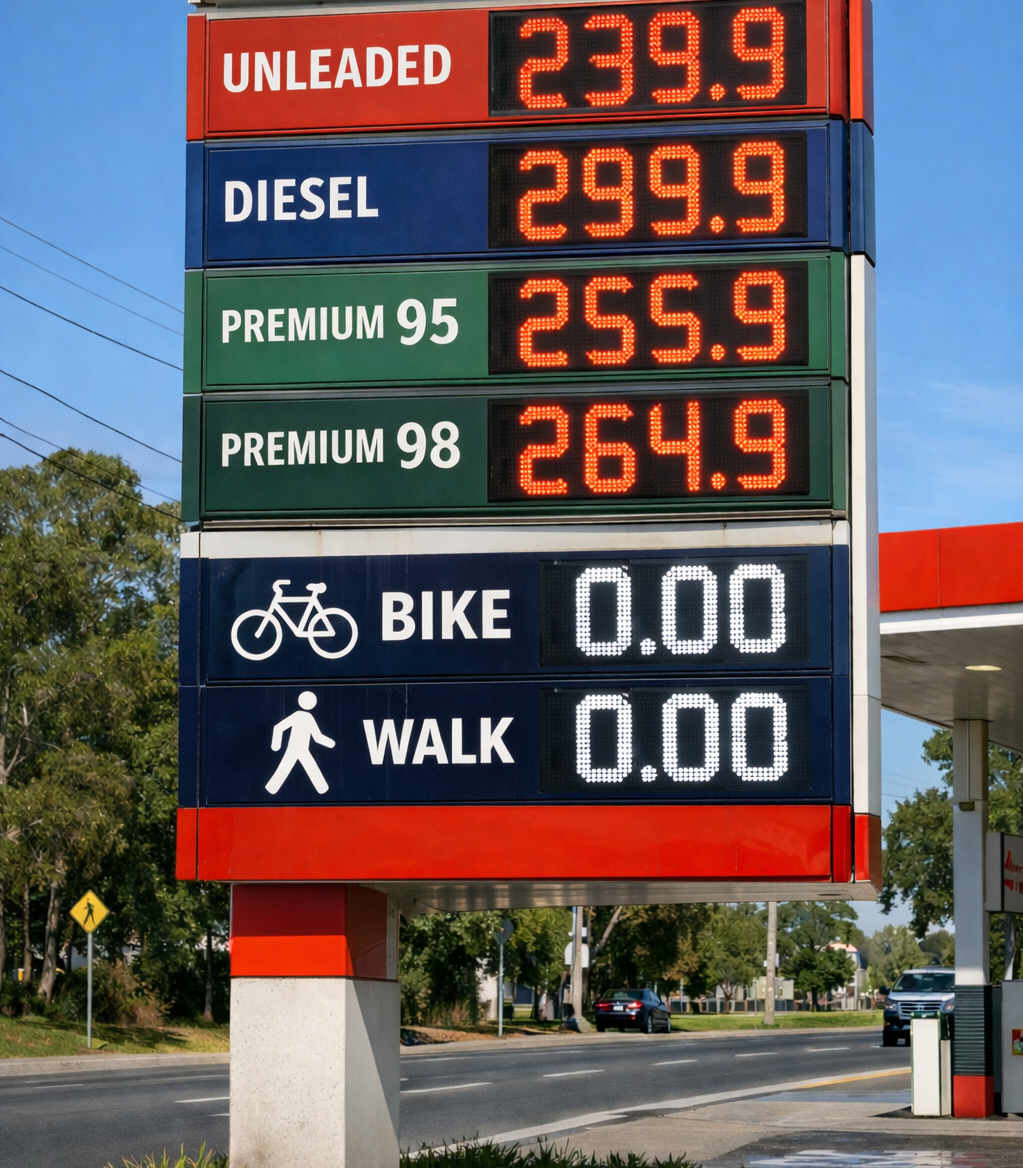
The International Energy Agency (IEA) has urged Australians to work from home where possible, avoid non-essential air travel, reduce road speeds and use public transport (Irvine, 2026). This is sensible short-term advice, but if governments and transport leaders are paying attention, there is a longer-term opportunity: accelerate our transition to more sustainable modes of travel to reduce our dependence on volatile fossil fuels and cut costs for families.
The cost of fuel alone won’t shift behaviour
Higher fuel prices do change travel behaviour, but only when real alternatives exist. In large cities, shifts to public transport can happen within weeks (Zhang, T & Burke, P.J, 2020). While in smaller cities the effects take five to seven months (Litman, T, 2025). This points to one of Australia's most persistent transport planning failures. The mode-shift benefit of higher petrol prices is only realised where good alternatives to driving a car exist.
Why is Australia investing in the most fossil fuel dependent transport infrastructure in a fuel crisis?
Despite a fuel crisis, Australia continues to invest in the most fossil fuel–dependent form of transport. On March 30, 2026 the Australian Government announced a temporary cut to the fuel excise for 3 months, costing taxpayers $2.55 billion dollars - while urging people to use public transport without providing additional funding to support it or to expand walking and cycling networks (Australian Government, 2026).
The public transport systems in Australia are already straining. Decades of underinvestment in service frequency and network coverage - particularly in regional and remote locations. Frequency and reliability are still the main drivers for passenger satisfaction and confidence. Without significant improvements, higher fuel prices alone won’t encourage large-scale mode shift.
Electric vehicles may reduce fuel dependency, for those who can afford one, but they are not a near term solution at scale, a comprehensive electric vehicle fleet in Australia is decades away at best (Quiggin, J., 2021), and they do nothing to address the problem of congestion.
What governments should do now
Governments at all levels should treat the fuel crisis as a window of opportunity to take several interconnected actions immediately to reduce our reliance on fuel and provide meaningful cost of living relief to Australian families.
1.Accelerate investment and delivery of walking and cycling networks
One of the fastest and affordable ways to travel that is being overlooked in the media, is to make it easier for people to walk or ride a bike, especially for short trips (Lindsay, G., Macmillan, A., & Woodward, A, 2011).
Do Australians even want to ride a bike? Yes they would, if they felt safe
Research from Monash University (Pearson, L., & Beck, B., 2025) shows that more people would ride if they had more high-quality infrastructure that would make them feel safe. Cycling only accounts for around 1-2% of all trips in Australia (Goel, Rahul, Anna Goodman, Rachel Aldred, et al., 2022). However, research shows there is a striking latent demand - 78% of people in Greater Melbourne (Pearson, L., Gabbe, B., Reeder, S., & Beck, B, 2023) are interested in riding a bike. The boom in dockless shared e-bike usage in Sydney is noticeable, Lime bike usage in Sydney is the second-highest in the world after London (Brown, A., 2026).
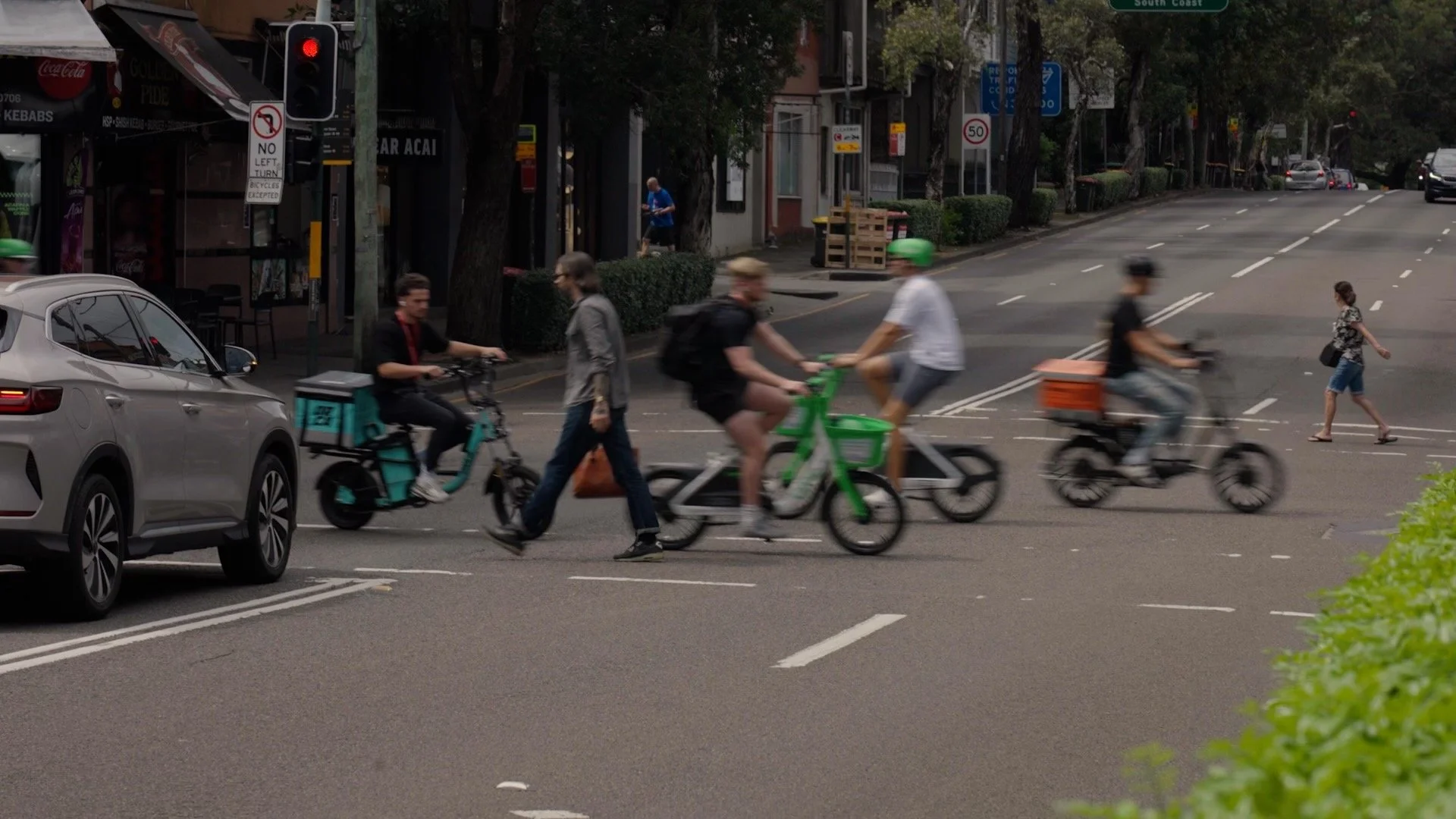
Photographer: Michael Power
Asking people to walk or ride a bike isn’t enough. We know that the biggest barrier to cycling is the perception of safety. Protected cycleways (physically separated from motor vehicle traffic) are the gold standard for making streets safer for everyone, including children and older people. Paris and Copenhagen have protected cycleways on over 40% of their total road network (Streets for Kids, 2025) and the rates of cycling are (respectively) 15% and 24% (CoC, 2022) of trips While in Australia less than 5% of our road network has protected cycleways for all major Australian cities.
Australian state and local governments need to build safe cycling networks. Currently Australia spends $714 per person on roads every year – but just 90 cents goes to walking, wheeling and cycling (McLaughlin, M., Ennis, G., & McCue, P, 2025). In New South Wales (NSW), the state government only spends 0.2%-1% of its transport budget on cycleways. The UN suggests the walking and cycling infrastructure should be 20% of the transport budget - which NSW Government agrees to "in principle" (Brown, A, 2026).
Accelerate investment in protected cycling infrastructure and pedestrian amenity in suburban areas to make active transport a real choice, not a brave one. Evidence is unambiguous that the "interested but concerned" cyclists — the majority of the population — will not shift until the safety of doing so is demonstrably improved.
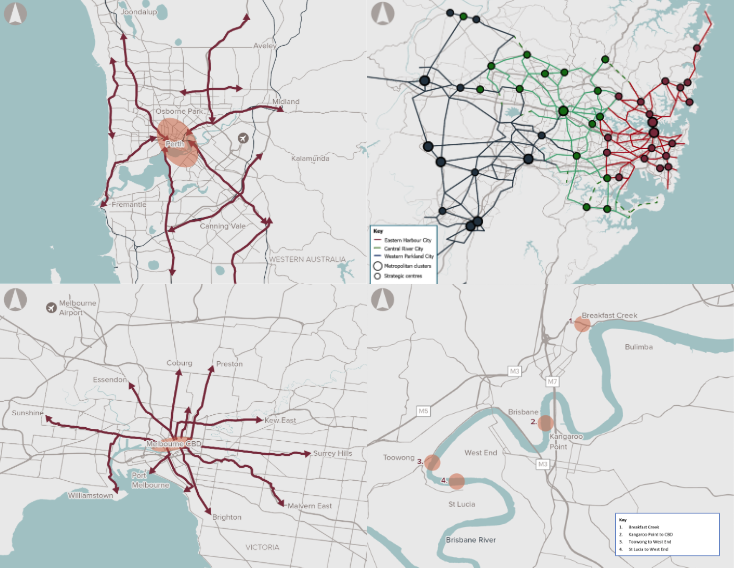
Image: Cycling networks listed on Infrastructure Australia. Source: Infrastructure Australia
2.Set up an e-Bike subsidy program
In 2021, We Ride Australia (IST, 2021) released a report calling for a national e-bike subsidy program to give more Australians the opportunity to ride. The case is simple: e-bikes provide families with an affordable way to cut emissions, avoid rising petrol costs and reduce time stuck in traffic.
The report highlights why they work. E-bikes allow people to travel further with less effort, making everyday trips more realistic. Studies show that people who own an e-bike ride around 50% more often than those with a regular bike, and their trips are on average 50% longer. They also broaden who can ride — increasing participation among women and helping address the long-standing gender imbalance in cycling.
Yet Australia’s policies are out of step. The Commonwealth’s support for electric vehicles is overwhelmingly focused on cars, not the much cheaper option of e-bikes. While some states have trialled small, short-term rebate programs, these have been limited in scale, quickly exhausted, and are no longer available. There is currently no consistent, nationwide support to help households make the switch.
A national e-bike subsidy is an obvious next step. It would give Australians a practical, affordable alternative to driving for short trips — the very trips most affected by fuel prices.
Better Streets recommends the Commonwealth Government introduce a national e-bike subsidy to reduce the upfront cost of purchasing or leasing an e-bike, with stronger support for concession-card holders and low-income households. If the goal is to ease cost-of-living pressures, this is one of the fastest and most effective transport policies available
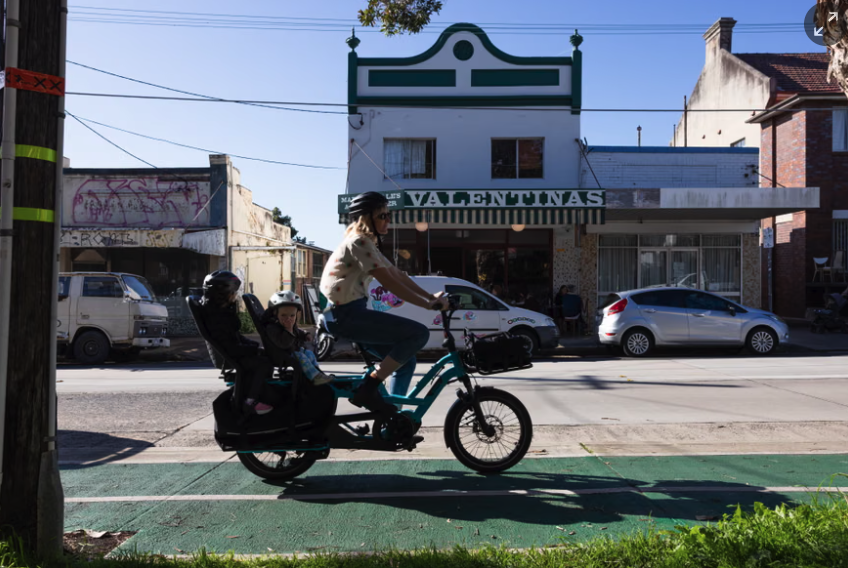
Photograph: Blake Sharp-Wiggins/The Guardian(2024). “I liked not getting in our car every day to travel short distances” The e-bike commute challenge: could I do daycare drop-off and get to work faster than driving? (Earl, C, 2024)
3.Set safe speed limits on local streets
Create safer streets for people to live, travel and work on by setting safer speed limits.
Reducing speed limits in local streets to 30km/h is one of the simplest and most effective ways to support people cycling and walking. The safety benefits are significant, if a person walking or riding a bike is hit by a car they have a 10% chance of surviving if that car was travelling at 50km/h but a 90% chance if it was travelling at 30km/h. A recent systematic review of cities that have implemented 30km/h speeds limits in Europe found that the benefits of 30km/h speed limits include (Yannis, G., & Michelaraki, E, 2024):
Higher rates of walking and cycling
Reductions in road crashes, fatalities and injuries
7% lower fuel consumption
Better air quality and less traffic noise
Only minimal increases in travel times for cars
Australia is already seeing these benefits. Cities and town centres that have introduced 30 km/h limits — including areas of Sydney, Melbourne (CoY, 2026), Adelaide and Perth (GoWA, 2021) — have demonstrated improvements in safety and stronger support for local walking and cycling.
If Governments are serious about helping families reduce the cost of living, then reducing fuel dependency by improving safety on our streets is essential. Better Streets recommends lowering speed limits on local streets to 30 km/h is an immediate, low-cost action that delivers multiple benefits at once.
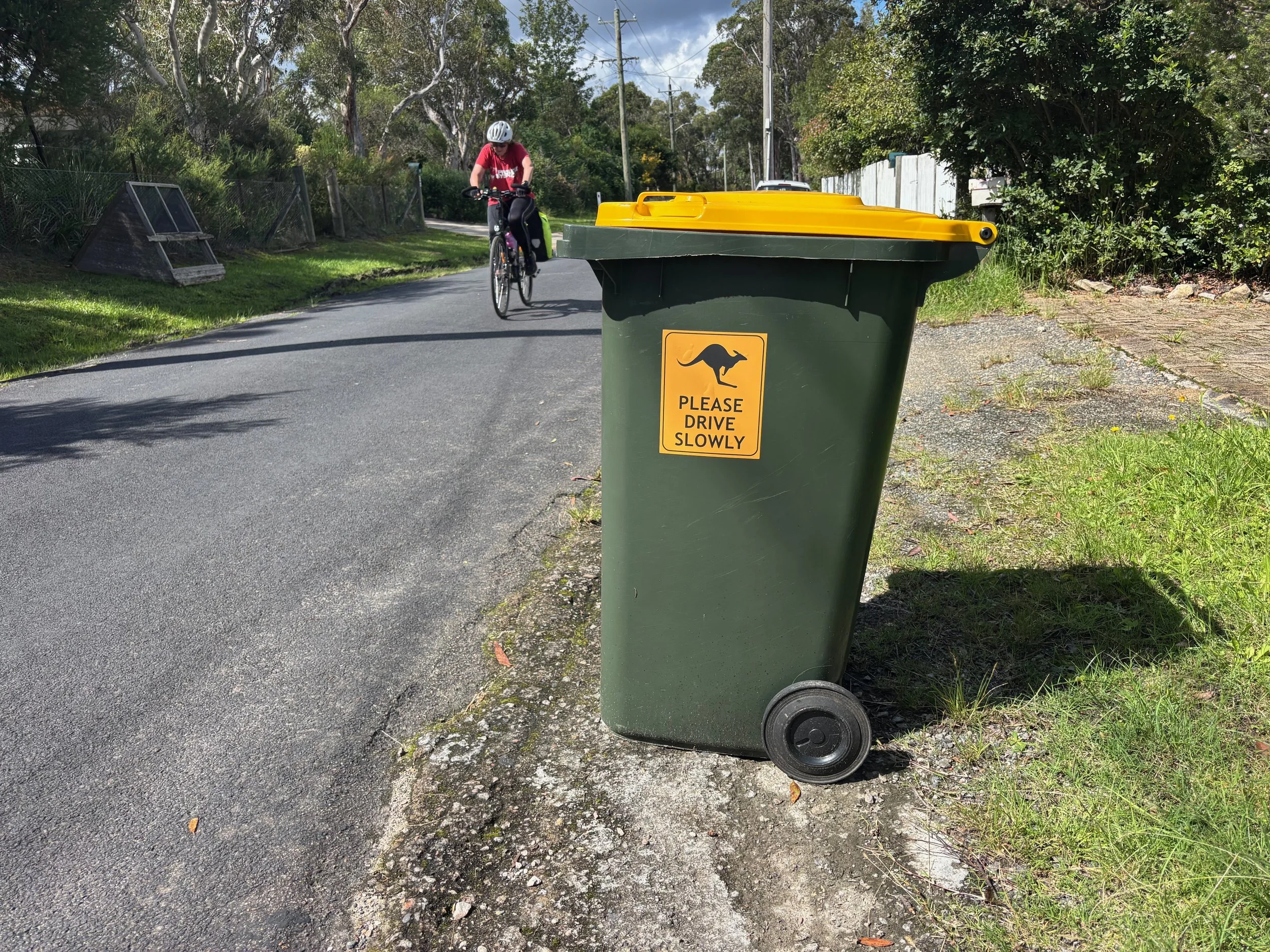
Photo: Wheelie bin sticker “Please Drive Slowly” in the Blue Mountains, New South Wales. Photographer: Jullietta Jung
4.Get kids active and create a School Streets program
Get kids active and give caretakers by funding and scaling School Streets programs
One of the fastest ways to cut household transport costs isn’t about fuel efficiency — it’s about fewer car trips altogether. The 2025 Australian School Travel Report (Kent et al. 2025) – a national survey of 4968 families, found that school travel is dominated by cars (61%). Most children live within walking or riding distance of school.
If you ask them, most kids want to be independently mobile (Romero 2007, Tranter, 2015). They want to walk, wheel, or ride bikes to school. And when they do, this saves their parents valuable time and money relative to when parents drive their kids to school. However, parents often see how car-dominated their streets and neighbourhoods are, and are concerned about the dangers of tar traffic (Swain et al. 2024).
‘Learning to Walk Again’ research (Murray, 2025) shows that there are a range of ways that we can improve people’s safety and health on streets and invite more kids to walk to school. These initiatives create better safety for kids through collective action (Zubrick et al 2010, Carver 2014).
School Streets are one of the simplest ways to do this. School Streets are about creating an environment that provides both physical safety and psychological sense of safety that kids will be safe walking or cycling to school by removing the dangers of cars from around the school. This is achieved by restricting car access outside schools at pick-up and drop-off times, they remove the primary barrier parents face: the danger of traffic.
There are existing examples in Australia, but they’re small and can be scaled with more resources and co-ordination:
Merri-bek, Victoria Ride & Stride families leading Open Streets
Fort Street Public School, New South Wales Sydney's very first School Street – Bicycle NSW
Queens Park Primary School, Western Australia Queens Park Primary - School Open Street
4.Deliver public transport improvements
Increase public transport service frequency, particularly in middle-ring and outer suburbs where car dependency is highest and where residents are most exposed to fuel price shocks.
Fare freezes or free travel periods during acute supply shocks are worth considering but as short-term demand enablers. The Victorian and Tasmania Governments have done just that - public transport will be free for the next three months in Victoria and then next six months in Tasmania (Gregg, F., 2026).
Data from recent state initiatives that trial low or no-cost fares - like the 50c bus fare initiative in Brisbane - show an uplift in patronage but impact is limited without improvements to service frequency and coverage (McKay, J., 2025).
Better Streets urges Governments not to waste this crisis
Price shocks are blunt instruments. They cause real hardship, particularly for lower-income households in car-dependent outer suburbs with no viable alternatives. But they also create moments of openness to change that are otherwise rare in transport planning, a field notorious for entrenched patterns and infrastructure lock-in. When people are already reassessing their routines — because the cost of the car-dependent status quo has suddenly risen — they become far more receptive to trying alternatives.
There are clear historical precedents - the 1973 oil crisis was a turning point for the Netherlands that responded to rocketing petrol prices by mandating car-free Sundays. This initiative not only achieved the intended aim of conserving petrol reserves but had the unintended benefits of improving air quality, demonstrating the feasibility of cycling as a mode of transportation and catalysing grassroots activists opposed to car-centric urban planning and entrenched fossil-fuel dependency (Taylor, M., & Fujita, S., 2025).
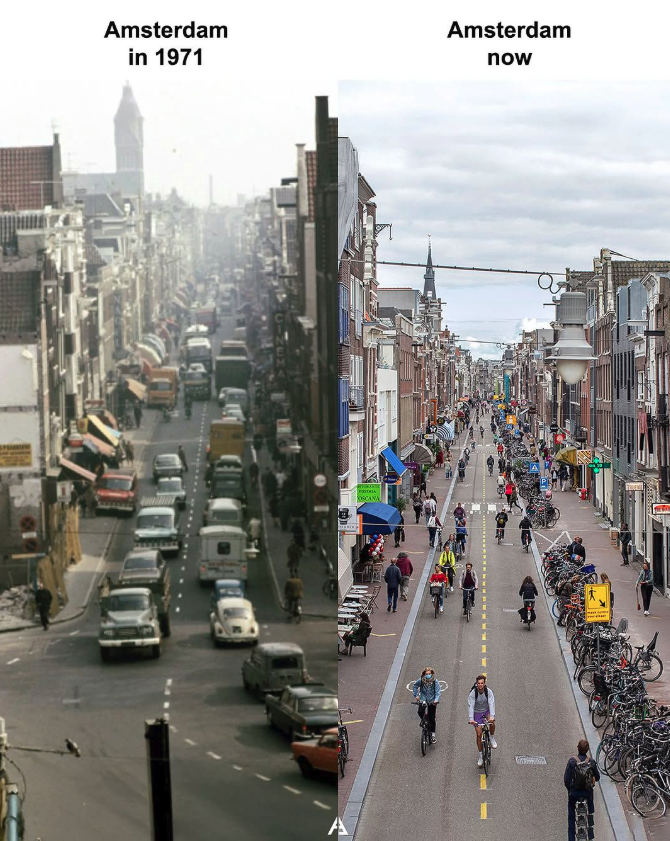
Image: Amsterdam in 1971 and now (2026).
A more recent and close to home example is the success of pop-up cycleways constructed during the COVID-19 pandemic. For example on Pitt Street in Sydney’s CBD, the weekly bike trips increased by 500% after the pop-up cycleway opened in 2020 (CoS, 2021). Uptake was so successful the pop-up infrastructure was subsequently replaced with a permanent concrete barrier. Pop-up cycleways are a particularly quick and cost-effective investment able to reduce car dependence immediately.
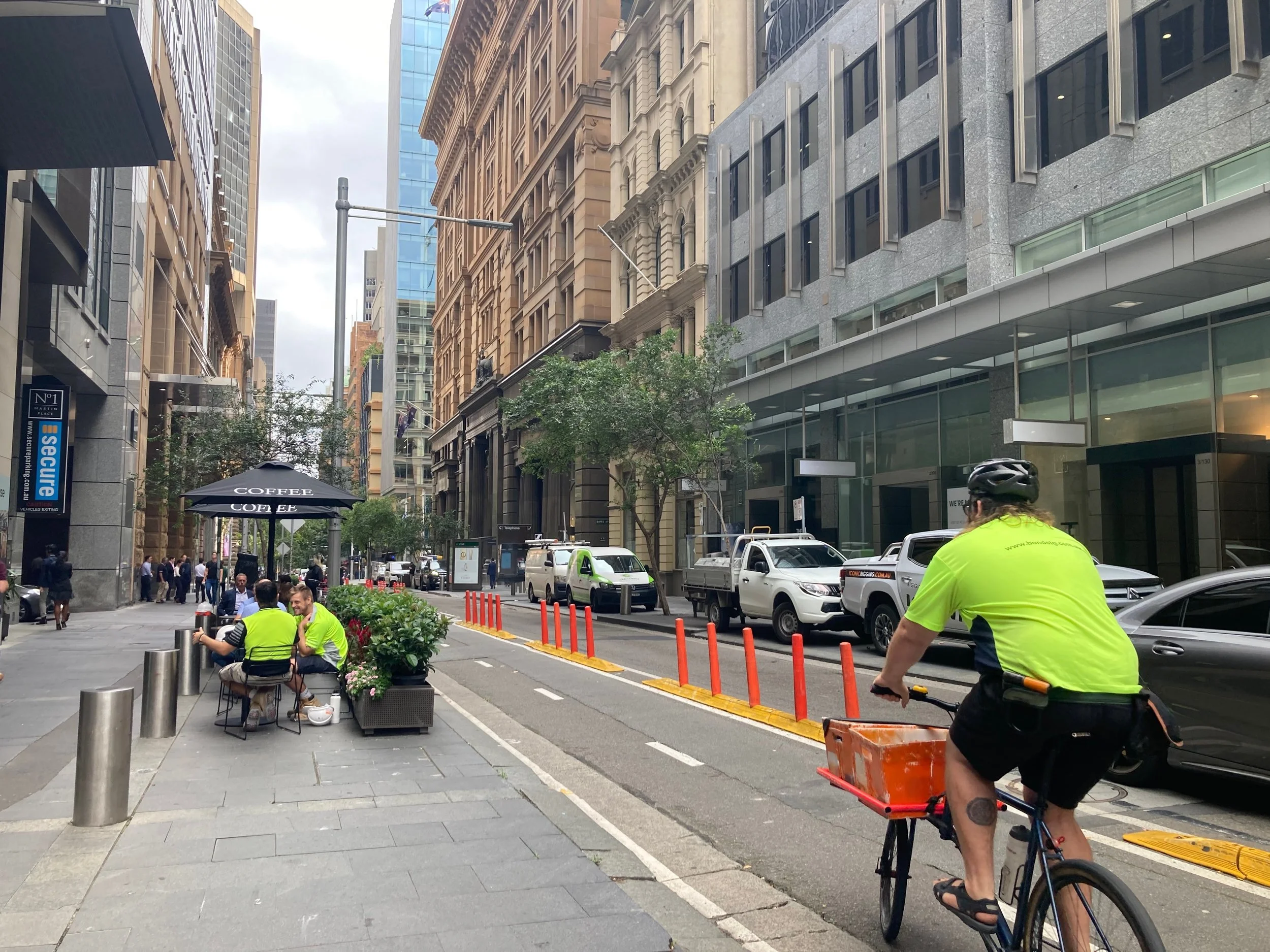
Image: Cargo freight delivery rider on the Pitt Street pop-up cycleway during COVID19. Photographer: Jullietta Jung
The silver lining to this fuel crisis is that it’s created the perfect conditions for mode shift and creating a resilient transport system — economic motivation, public attention, and political permission to act — are aligned ready for governments to act.
The question is whether our planners and governments are nimble enough to act while the window is open.
Written and researched by
Jamie-Lee Owen is a Network Planning & Change Leader at Metro Trains Melbourne, specialising in transport planning and large-scale operational change. Former Chair of PTAANZ's Emerging Mobility Leaders and Producer of the Women Who Move Nations podcast, she sits at the intersection of cities, people, and movement.
LinkedIn: https://au.linkedin.com/in/jleeowen
Kate Ridgway is an education researcher with a background in psychology and public health. She has spent the last decade investigating how children and young people develop and how parents, teachers and the broader community can best support.
LinkedIn: https://au.linkedin.com/in/kate-ridgway-82471215b
Jullietta Jung is the President of Better Streets. She is a sustainable mobility professional with over a decade of experience working with governments in Australia to deliver high-impact active transport projects and programs and strategic investment decisions aimed at urban transformation to improve the liveability of cities.
LinkedIn: https://www.linkedin.com/in/jullietta-jung/
References
Australian Government, Department of Infrastructure, Transport, DIT (2026). “Fuel Excise Halved for Three Months.” March 30, 2026. https://minister.infrastructure.gov.au/c-king/media-release/fuel-excise-halved-three-months
Brown, A. (2026) Parking politics and “crappy” bike lanes stifling a cycling boom in Sydney. ABC News.https://www.abc.net.au/news/2026-03-19/inner-west-lagging-on-bike-lanes-riders-say/106460182
City of Copenhagen. (2022). The BIcycle account 2022 Copenhagen City of Cyclists.
City of Sydney (2021). “Project Scope - Pitt Street North Walking and Cycling Improvements.” May 10, 2021.https://meetings.cityofsydney.nsw.gov.au/documents/s52207/Project%20Scope%20-%20Pitt%20Street%20North%20Walking%20and%20Cycling%20Improvements.pdf.
City of Yarra. (n.d.). About the trial | 30km speed limit trial in Fitzroy and Collingwood | Your Say Yarra. Retrieved March 31, 2026, from https://yoursayyarra.com.au/30km/about-trial
Earl, C. (2024). The ebike commute challenge: Could I do daycare drop-off and get to work faster than driving? | Australian lifestyle | The Guardian.https://www.theguardian.com/lifeandstyle/article/2024/aug/04/the-ebike-commute-challenge-could-i-do-daycare-drop-off-and-get-to-work-faster-than-driving
Gregg, F. (2026). Victoria and Tasmania have made public transport free. Here’s when it kicks in—ABC News. ABC News.https://www.abc.net.au/news/2026-03-30/victoria-and-tasmania-free-public-transport/106512252
Goel, Rahul, Anna Goodman, Rachel Aldred, et al. “Cycling Behaviour in 17 Countries across 6 Continents: Levels of Cycling, Who Cycles, for What Purpose, and How Far?” Transport Reviews 42, no. 1 (2022): 58–81.https://doi.org/10.1080/01441647.2021.1915898.
Government of Western Australia, Department of Transport and Major Infrastructure. (2021). Assessing Safe Operating Speeds on 30 km/hr Streets Using 85th Percentile Speed Thresholds. Retrievedhttps://www.transport.wa.gov.au/getmedia/b9ba1661-41b0-4301-af40-0027814c6220/AT_P_Assessing85thPercentileSpeeds.pdf
Institute for Sensible Transport. “E-Bike Subsidy Report Prepared for We Ride Australia.” Report. We Ride Australia, November 2021. https://www.weride.org.au/wp-content/uploads/2022/04/WeRide_e-Bike_Subsidy_Report_FINAL-lores.pdf.
Irvine, S. (2026). IEA tells drivers slow down or take the bus as oil crisis bites. Australian Financial Review.https://www.afr.com/policy/energy-and-climate/iea-tells-drivers-slow-down-or-take-the-bus-as-oil-crisis-bites-20260323-p5rnfk
Kent, J.L., Hossein Rashidi, L., Moylan, E., Delbosc, A. (2026) The Australian School Travel Survey 2025. The University of Sydney, Darlington.
Lee, D. (2026). Australia Fuel Crisis Deepens in March 2026: Panic Buying, Soaring Prices and Supply Warnings. International Business Times.https://www.ibtimes.com.au/australia-fuel-crisis-deepens-march-2026-panic-buying-soaring-prices-supply-warnings-1864000
Lindsay, G., Macmillan, A., & Woodward, A. (2011). Moving urban trips from cars to bicycles: Impact on health and emissions. Australian and New Zealand Journal of Public Health, 35(1), 54–60.https://doi.org/10.1111/j.1753-6405.2010.00621.x
Litman, T. (2025). Transit Price Elasticities and Cross-Elasticities. Victoria Transport Policy Institute.www.vtpi.org/tranelas.pdf
McKay, J. (2025). Queensland’s 50c fares have hit the six-month mark. Here’s the verdict. ABC News.https://www.abc.net.au/news/2025-02-10/queensland-50c-fares-public-transport-analysis/104910866
McLaughlin, M., Ennis, G., & McCue, P. (2025). Australia spends $714 per person on roads every year – but just 90 cents goes to walking, wheeling and cycling. UNSW Sites. https://www.unsw.edu.au/newsroom/news/2025/02/australia-spends-714-per-person-on-roads-every-year-but-just-90-cents-goes-to-walking-wheeling-and-cycling
Murray, P (2025). Learning to Walk Again. https://learningtowalkagain.org/
NRMA (2026). “Weekly Fuel Report | Petrol Price News | The NRMA.” Accessed March 27, 2026. https://www.mynrma.com.au/cars-and-driving/fuel-finder/weekly-report.
Pearson, L., & Beck, B. (2025). Shifting gears: How do we shift people from private cars to walking and cycling? Monash Lens.https://lens.monash.edu/how-do-we-shift-people-from-private-cars-to-walking-and-cycling-heres-what-the-evidence-suggests/
Pearson, L., Gabbe, B., Reeder, S., & Beck, B. (2023). Barriers and enablers of bike riding for transport and recreational purposes in Australia. Journal of Transport & Health, 28, 101538.https://doi.org/10.1016/j.jth.2022.101538
Quiggin, J. (2021). Government assumes 90% of Australia’s new car sales will be electric by 2050. But it’s a destination without a route. The Conversation.https://doi.org/10.64628/AA.jefay4yv4
Romero V, 2015, Children's experiences: Enjoyment and fun as additional encouragement for walking to school, Journal of Transport and Health 2015.
“Streets for Kids, Cities for All: Protected Cycling Infrastructure Ranking.” Clean Cities Campaign, n.d. Accessed March 27, 2026.https://cleancitiescampaign.org/city-ranking-2025-cycling-infrastructure/
Swain R, Oswin P, Truelove V, Larue G, 2024, Children's and parents' perceptions on safe routes to schools: a mixed-methods study investigating factors influencing active school travel, Journal of Urban Design 29:2.
Taylor, M., & Fujita, S. (2025). How crises and social movements can build momentum for alternative mobility visions. In Advances in Transport Policy and Planning (Vol. 16, pp. 189–245). Academic Press. https://doi.org/10.1016/bs.atpp.2025.07.003
Tranter P, 2015, Children's Play in their Local Neighbourhoods: Rediscovering the value of residential streets, Play, Recreation, Health and Well Being, Geographies of Children and Young People 9, Springer Science + Business Media, Singapore.
Yannis, G., & Michelaraki, E. (2024). Review of City-Wide 30 km/h Speed Limit Benefits in Europe. Sustainability, 16(11), 4382.https://doi.org/10.3390/su16114382
Zhang, T., & Burke, P. J. (2020). The effect of fuel prices on traffic flows: Evidence from New South Wales. Transportation Research Part A: Policy and Practice, 141, 502–522.https://doi.org/10.1016/j.tra.2020.09.025
