Sydney's First GreenWay: What 25 Years of Advocacy Taught Us About Building Better Cities
“It’s a demonstration of what happens when the community leads and the government listens - and when all levels of government work together.”
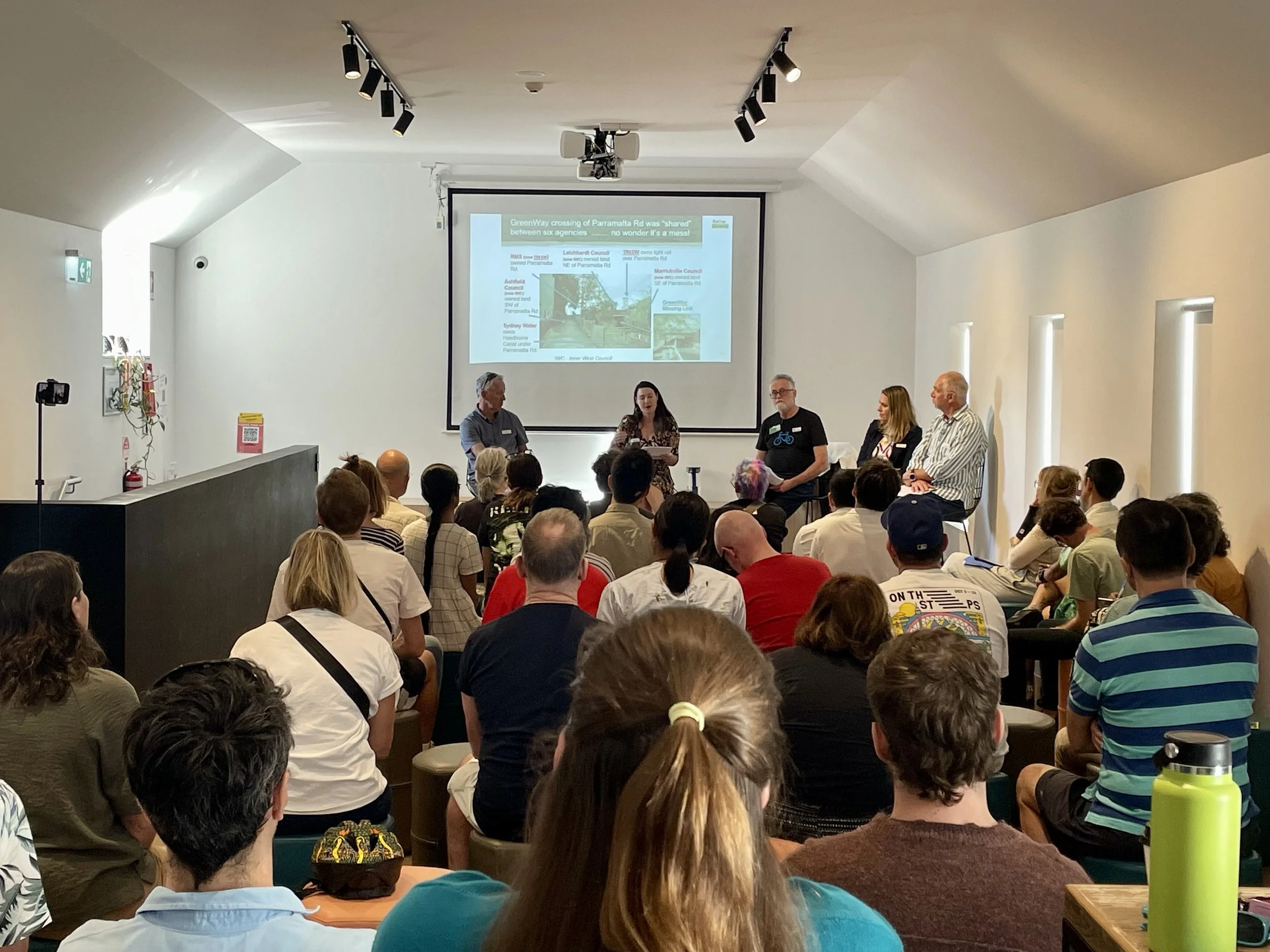
On a warm Sunday afternoon in Summer Hill - just a short walk from the GreenWay itself - over 40 advocates, planners, councillors, and residents gathered for Better Streets Australia's panel event: Sydney's First GreenWay – From Vision to Reality. The conversation that followed was an energising, and honest discussions about what it actually takes to reshape a city.
The panel brought together four people whose contributions span the GreenWay's entire history: Bruce Ashley, who helped plant its seeds in the late 1990s; Nick Chapman, who began as a GreenWay advocate and later served as the Greenway Place Manager; Kobi Shetty MP for Balmain, former Inner West Councillor, now the NSW Greens spokesperson for active transport and sustainable cities; and Cr Kerrie Fergusson of Inner West Council. They were joined by an audience with its own significant stake in the project - including residents of Weston Street, who live with the GreenWay's growing pains every day.
Here are our key takeaways.
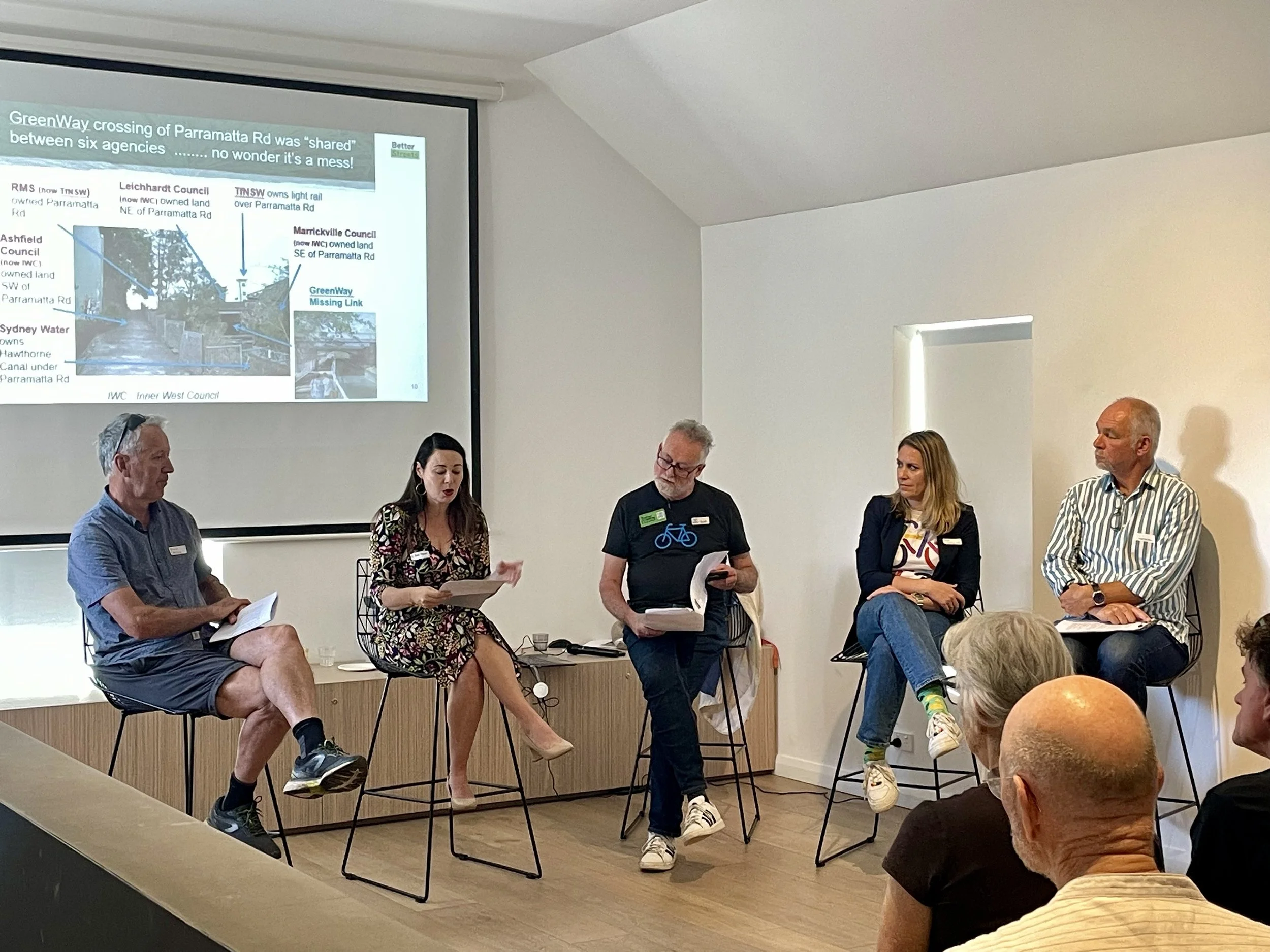
The GreenWay discussion panel consisting (from left to right) of: Bruce Ashley, Cr Kerrie Fergusson, Moderator Matt Faber, Kobi Shetty MP and Nick Chapman.
A 25-year vision held together by volunteers and strategic patience
Bruce Ashley began community organising around the former Rozelle goods rail line in the late 90’s, drawing on studies he'd contributed to in the late 1980s and his experience of European greenways. What sustained the project through a quarter-century of uncertain funding, stalled light rail debates, and changing governments was not any single breakthrough, it was the accumulation of strategic documents, a multi-council steering committee, hundreds of volunteer hours across more than a dozen bush care sites, and a "top-down vision" flexible enough to survive the politics beneath it.
"If you've got the right direction," Bruce said, "those things will eventually be overcome."
Nick Chapman, who joined forces with Bruce as a GreenWay advocate in the late 90’s and later became the GreenWay Place Manager in 2012, expanded on this: by the time council wound up the place management program in 2020, the GreenWay had unlocked seven hectares of new public open space, land already in public ownership, held by Sydney Trains and Sydney Water, with only one compulsory property acquisition required. The lesson? Public assets already exist. The challenge is convincing the agencies that hold them to share.
The GreenWay succeeded because it was never just a bike path
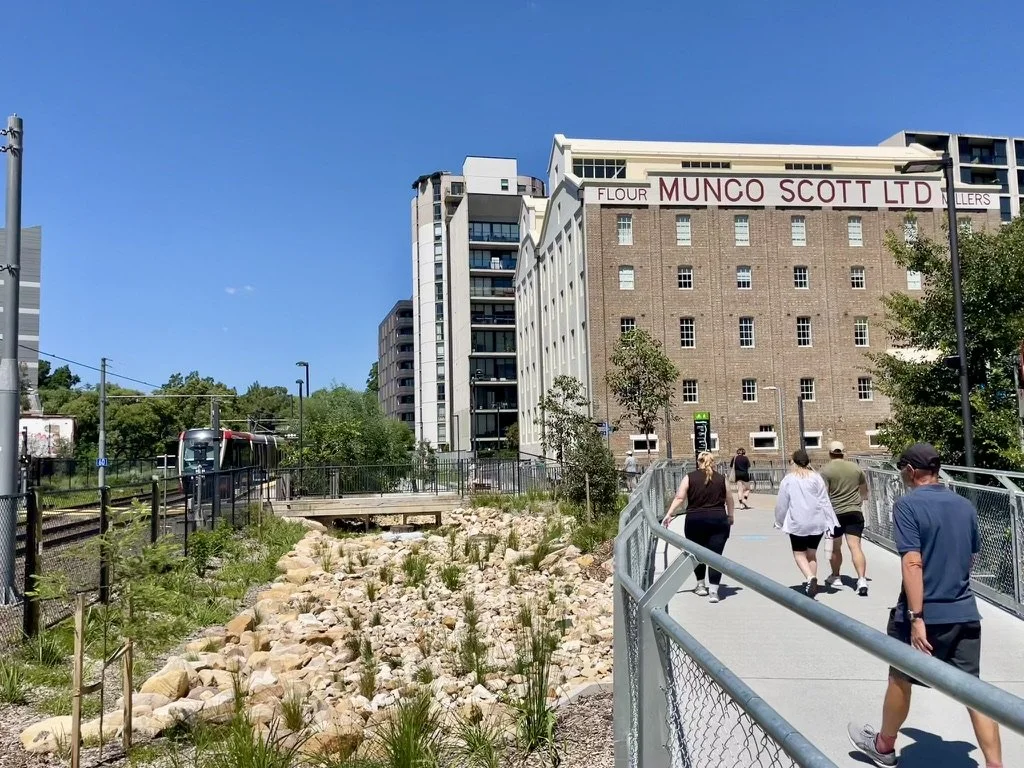
This was perhaps the panel's most repeated insight. Nick described five parallel streams that ran alongside the infrastructure campaign: activating the nine light rail stops as placemaking opportunities; completing the "missing links" under Paramatta Road to make the route genuinely usable; establishing bush care sites (now approximately eleven sites, mostly still maintained by volunteers); running a public arts program, including a $1M public art budget they fought hard to protect from engineering budgets, and a schools education program that took 1,500 students on GreenWay field trips over a decade.
Kobi Shetty MP reinforced this: "By having a focus on biodiversity, greening, and public art in a place where communities really care about the environment, that's what brought people along on the journey."
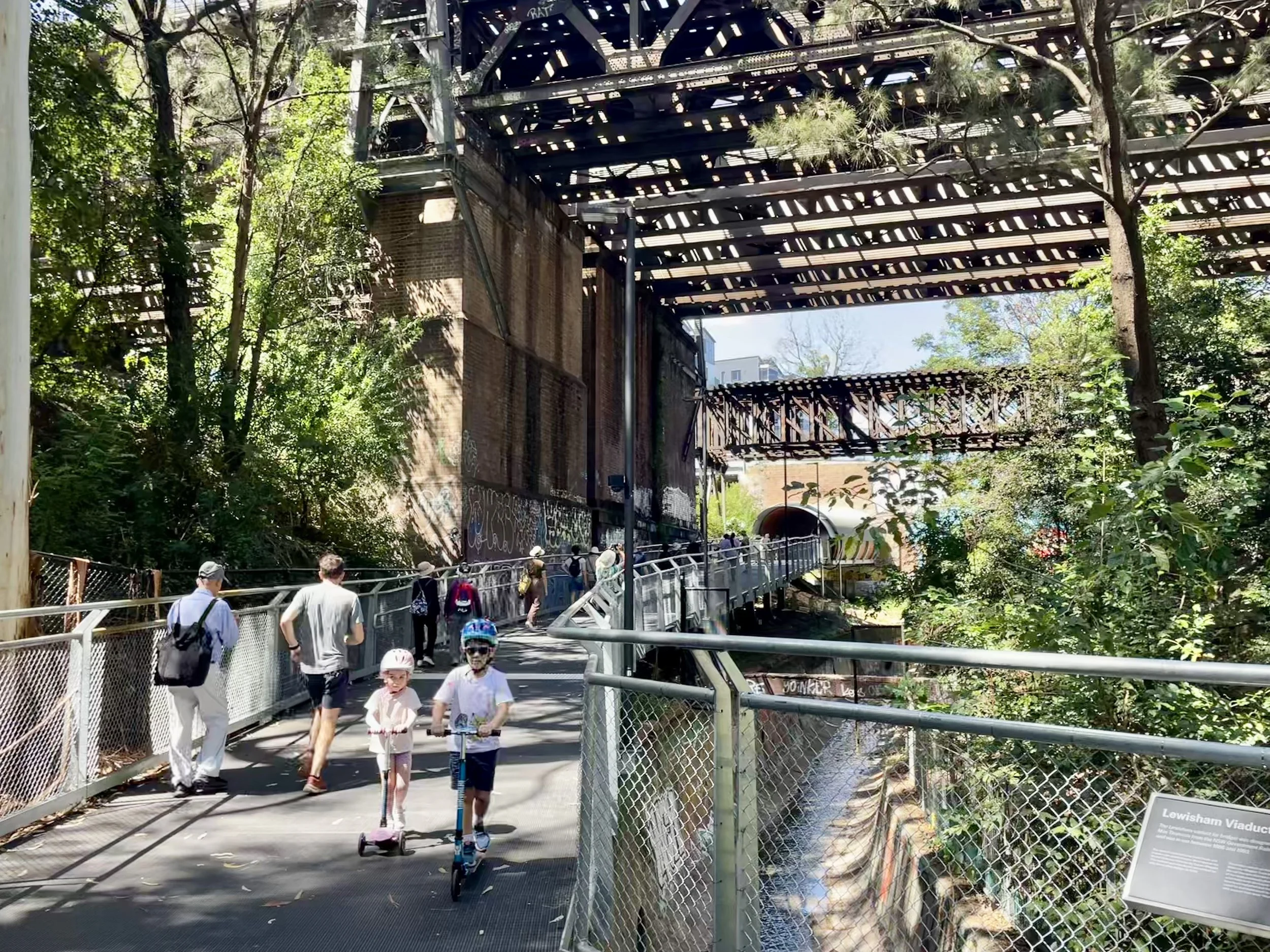
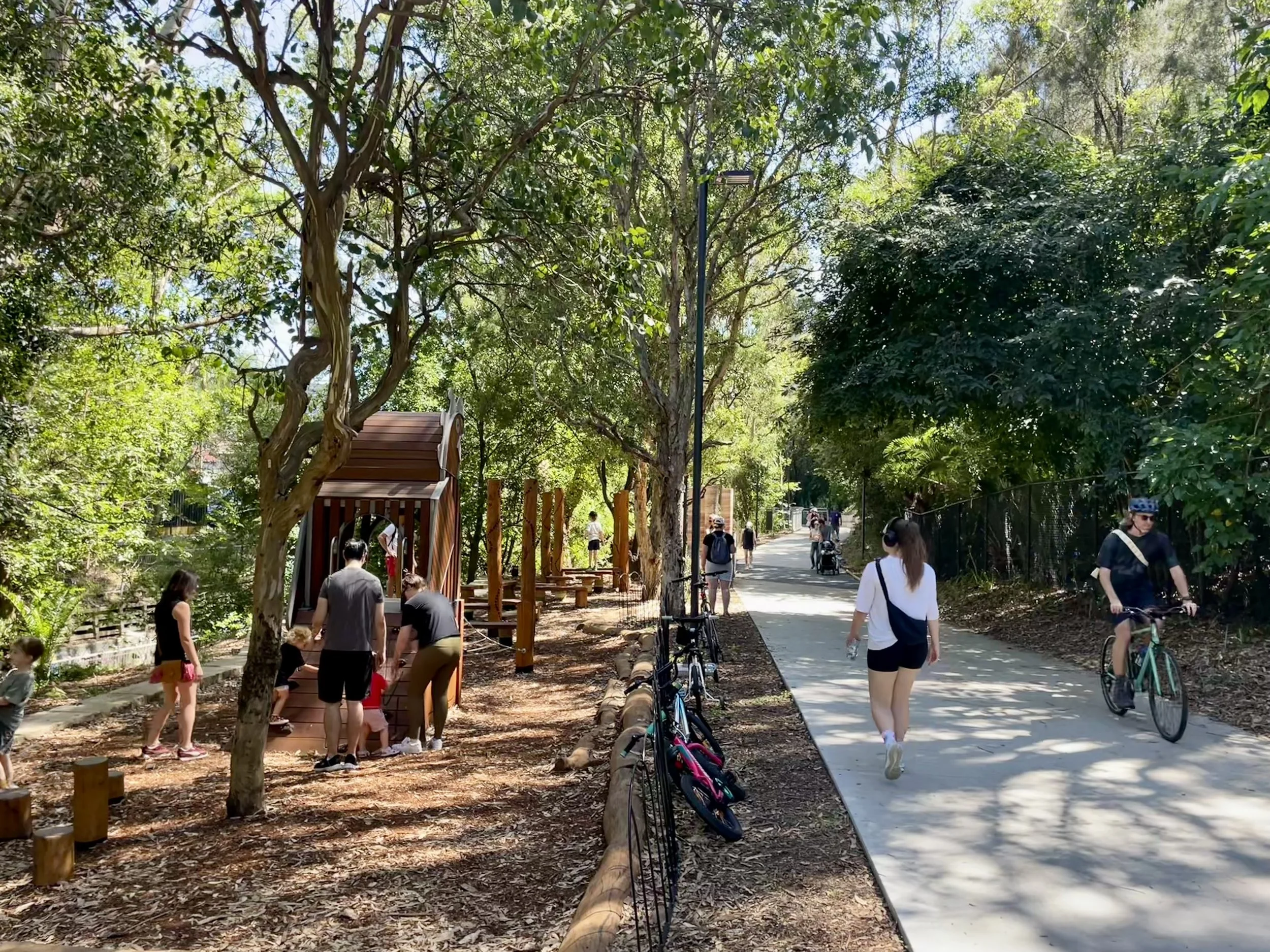
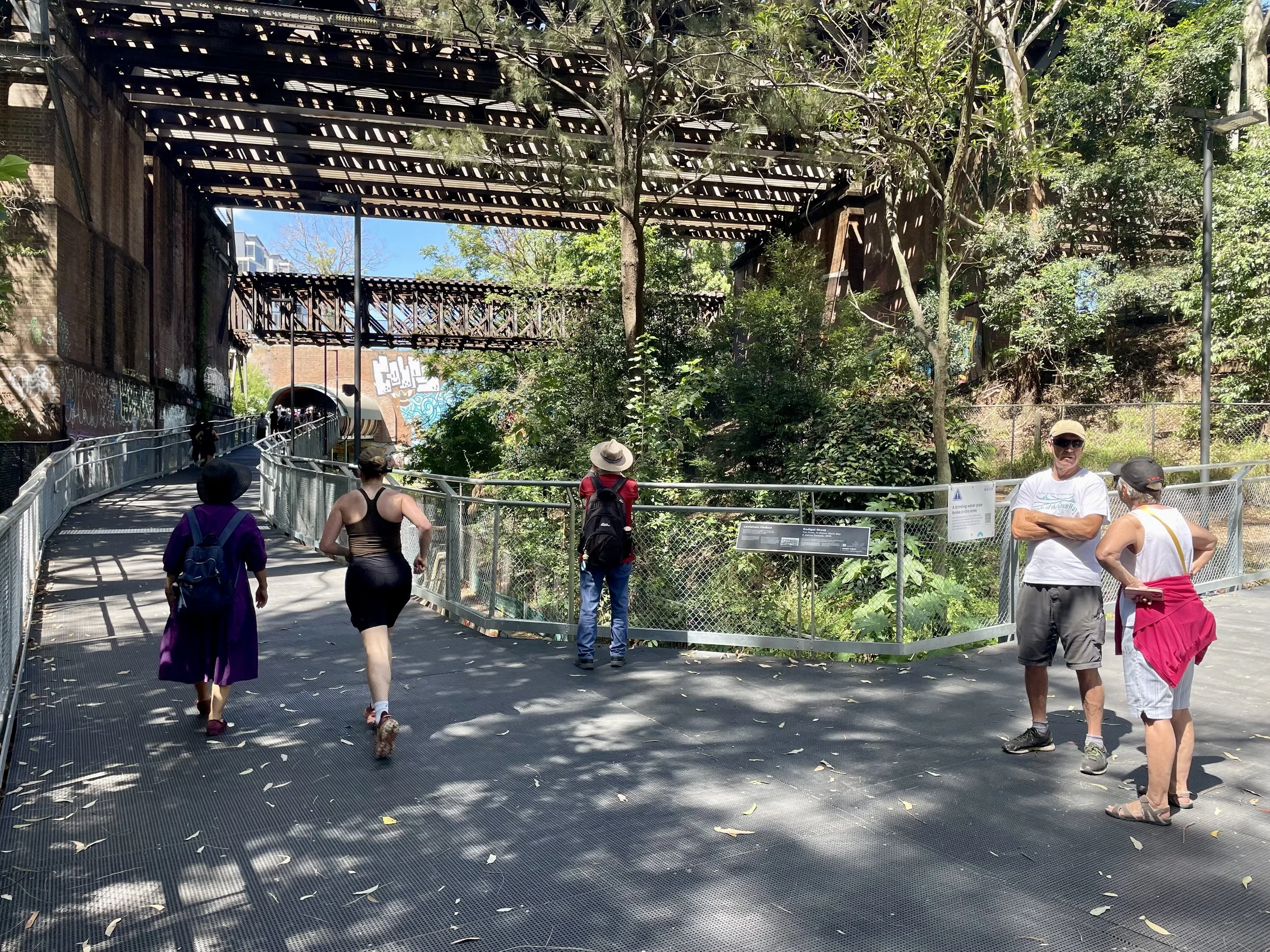
The GreenWay is now a destination. Usage tripled in its first fortnight of opening. Runners, cyclists, parents with prams, seniors, teenagers, the corridor is reaching people that a conventional bike lane never would have.
Funding remains a structural failure — and that's a state government problem
The panel was direct about the political economy of active transport. Kobi Shetty MP noted that the state government spends less than 1% of its transport budget on cycling infrastructure, against a UN recommendation of 20%. Local councils deliver most of the infrastructure, but the money flows from state government, which means the strategic ambition is being set at the wrong level.
"If the state government had a concerted push to fund walking and cycling better, they could make a huge impact across the city," Kobi said. Meanwhile, billions are directed to road projects, with "crumbs" flowing to councils for active transport.
Cr Kerrie Fergusson spoke to the challenge from council's side: elected representatives frequently face resistance when spending on bike lanes, caught between community advocates and a broader constituency still oriented around "roads, rates, and rubbish." Getting the GreenWay over the line, particularly securing grant funding to deliver the best version of the under-road connections rather than cheaper shortcuts, required sustained pressure from elected members who understood what was at stake.
The GreenWay is a springboard, not a finish line
If there was a consistent thread through the afternoon, it was this: the GreenWay proves that transformative active transport infrastructure generates its own momentum, and that momentum must be used. Kobi is pushing for the Glebe Island Bridge to reopen as a walking and cycling link connecting Rozelle and Pyrmont. Inner West Council is auditing active transport infrastructure across the LGA, reviewing school street safety, harmonising speed limits, and developing an integrated transport strategy that treats the GreenWay as a spine from which "fishbone" connections into local streets can grow.
Nick framed this through the lens of the Greater Cities Commission's green grid - a metropolitan network of green corridors that the GreenWay now demonstrates is possible. In a densifying Sydney where more residents will live in apartments without private outdoor space, these corridors aren't a luxury. They're essential climate infrastructure.
The voices of those living with it matter too
The afternoon included a candid exchange with Weston Street residents, who raised legitimate concerns about safety, speed, the absence of a pre-opening patronage study, and what genuine co-design of shared space actually looks like. Nick acknowledged these directly: "There's a really burning need to survey those users and to also educate. And it's got to be a co-design process with the people who are living there."
Kerrie confirmed council has since put forward a motion to address these issues and is actively working through them. This is worth noting not as a footnote, but as a principle: projects that "exceed all expectations" can only be evaluated honestly if baseline data was collected before opening. That's a lesson for every greenway-style project that follows.
What advocacy groups can learn from the GreenWay — and apply right now
Reflecting back, the example of King Street in Newtown, raised by Alice from Project K-Shift - a community group working to reimagine one of Sydney's most contested high streets, was a good reminder of where lessons from the GreenWay can be applied to other places and projects. King Street sits across two local government areas, with Transport for NSW controlling the road corridor, making it exactly the kind of multi-stakeholder, multi-level governance tangle that stalls projects for decades. Sound familiar?
The GreenWay faced the same structural problem. Bruce's early contribution was simply to map it: who owns what, at what level of government, and what decisions do they control? Federal, state, council, private landholders, the GreenWay corridor crossed all of them. Getting that picture onto paper, and then building relationships with the officers who hold the actual files, was foundational. "You can have some great words and push and publicise," Bruce said, "but at the end of the day you will need to be talking to the council officer that has the files."
Nick pointed toward something bigger: the concept of the green grid, the idea that individual corridors like the GreenWay, or a reimagined King Street, aren't standalone projects but nodes in a metropolitan network. Framing a project within that larger vision gives it strategic weight beyond its local footprint, add visuals of what this can look like, and it will make it easier to attract community support, and eventually state-level attention and funding.
From Kobi came the most pointed political advice: don't just lobby politicians - bring the conversation to them in structured settings. The NSW Parliamentary Friends of Active Transport exists precisely for this. Kobi's invitation was direct: if your group has evidence, stories, or expertise, she wants to help get you in front of that cross-party group. Shifting the Overton window, as she put it, requires showing up repeatedly with people who can make the abstract concrete.
And from Kerrie, a grounding reminder about where political will ultimately come from: "Advocacy groups are great, interest groups are great, but at the end of the day we actually need the everyday person on board with the vision." The GreenWay built its coalition not just through formal submissions and council meetings, but through bush care mornings, school excursions, and an annual art exhibition now in its 17th year. Every person who participated in community events throughout the years became a stakeholder. If King Street, or any similar project, is going to move, it needs the same breadth of community investment, not just a committed core.
The throughline is this: start with the map (who controls what), build the coalition wide (not just the usual suspects), connect your project to a larger strategic frame, engage the bureaucrats as well as the elected members, and don't underestimate the slow accumulation of goodwill that comes from showing up, year after year, to do the unglamorous work.
What does 2055 look like?
We closed by asking each panellist to cast their imagination thirty years forward. Kerrie hoped the GreenWay would simply be taken for granted - woven so naturally into daily life that no one thinks to remark on it. Nick hoped it would spark a broader green grid across metropolitan Sydney. Kobi imagined a city where people look back at six-lane arterials cutting through suburbs and think, wasn't that stupid? Bruce looked forward to the day the GreenWay would be “weed-free (by ’33)”, and to the animals and plants that would, by then, be telling their own story of what 25 years of patient restoration had made possible.
That's the kind of long-game thinking that built the GreenWay in the first place. And it's exactly the kind of thinking we need to carry forward.
However, this model may not work for everyone, but that’s a story for another time…
Better Streets Australia thanks our panellists, moderator (and Better Streets Secretary) Matt Faber, host (and Better Streets President) Jullietta Jung, and everyone who attended, asked questions, and shared their experience of the GreenWay. Special thanks to Board Director Louise Popowitz and volunteer Helen Kruger for organising the event, and to Mountain Air Foundation for their support.
Want to know more about the first Sydney GreenWay? We’ve got you covered with this article.
To stay across our campaigns - including our current work on safe speeds - join our newsletter and consider becoming a member.