
Who Sets Speed Limits in Australia?
Speed limits in Australia are not set by councils or the federal government. They are approved by state and territory governments, usually through the transport department or a transport commissioner.
While councils can request changes to speed limits on local streets, the final decision always sits with the state or territory authority.
The role of the Australian Road Rules
Across the country, speed limits are guided by the Australian Road Rules (ARR). These are national model laws designed to keep speed limit settings consistent between states and territories.
Under the ARR, default speed limits apply where there is no sign-posted speed limit:
50 km/h in built-up areas (such as local streets)
100 km/h outside built-up areas
These defaults are used in every state and territory, with the exception of the Northern Territory.
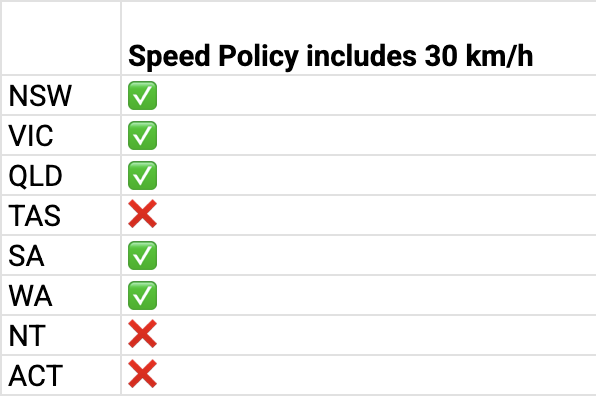
State policies and 30 km/h limits
Each state and territory has its own speed management policies or guidelines that explain how speed limits are reviewed and changed. These policies are generally based on the Australian Road Rules and Austroads guidance, but they vary in how flexible they are.
Some states and territories have policies that allow 30 km/h speed limits on local streets and in high pedestrian areas. Others do not, making it difficult or impossible for councils to implement safer speeds, even where communities support them.
Why this matters
Because default speed limits are set at the state level, meaningful change requires state governments to update their policies. Without this, councils are left navigating slow, complex, and piecemeal processes to introduce safer speeds — even when the evidence is clear and community support is strong.
